
AI Embedded Analytics vs Traditional BI: Guide for SaaS (2026)

Alim Goulamhoussen
Publié le 12.02.26
Mis à jour le 17.04.26
7 min
When you're building a SaaS product, the embedded analytics question comes up fast. Your customers are asking for dashboards. Your CS team wants automated reports. Your product roadmap has had "analytics" on it for 6 months.
If you're looking for the full picture before diving into this comparison, our complete guide to AI-powered analytics is the right starting point.
But which approach should you choose? Traditional BI with pre-built dashboards? Or jump straight to AI embedded analytics with conversational capabilities?
Here's what nobody tells you: this isn't just a technology question. It's a product decision that will impact your differentiation, user adoption, and ability to scale.
Let's break down both approaches.
Key Takeaways
Traditional BI requires pre-built dashboards: every new customer question means a new development sprint (2 to 6 weeks). AI embedded analytics lets users ask questions in natural language and get answers in 3 seconds.
Adoption rates tell the story: traditional BI averages 30 to 40% adoption among non-technical users. Conversational AI analytics reaches 60 to 70% with the same audience.
The production-ready advantage: AI embedded analytics platforms like Toucan handle the full infrastructure complexity (permissions, row-level security, monitoring, multi-tenancy, audit logging), so SaaS teams ship analytics without building it themselves.
Self-service is the business case: when end users can explore data and get answers without opening an engineering ticket, support load drops and product engagement rises.
AI-first is not an experiment in 2026. SaaS companies embedding conversational analytics as a premium tier are seeing $50 to $150 per user per month in additional revenue.
Traditional BI Analytics: What You Need to Know
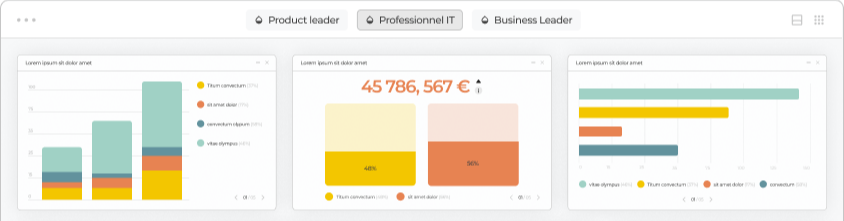
The traditional BI approach is what you've seen everywhere: pre-built dashboards, dropdown filters, chart libraries. You design a dashboard, embed it, and ship it.
The mechanics:
- Your team defines metrics and KPIs upfront
- Developers build dashboards using a BI tool (Tableau, Power BI, Looker)
- Users access these pre-configured views
- New questions = new dashboard development = sprint cycles
This works when:
- You have a narrow, well-defined use case. Example: "All our customers need the same 5 KPIs"
- Your users are analytics-savvy. Financial analysts, marketing ops teams who live in dashboards
- You need deep customization with calculated fields, complex filters, scheduled reports
The limitation? Every new question requires development work. Your customer asks "What's my retention by region?" - if you didn't build that view, they're stuck. Or they open a support ticket. Or they churn because your analytics don't answer their questions.
Find our Embedded Analytics tool comparaison page here.
Stop Building Dashboards. Start Shipping Answers.
Try for free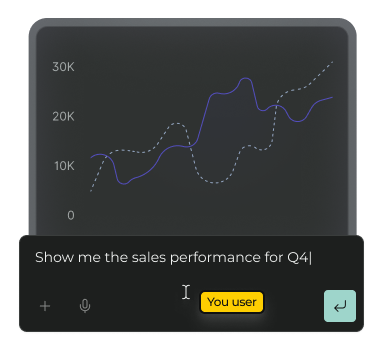
AI Embedded Analytics: The Modern Approach
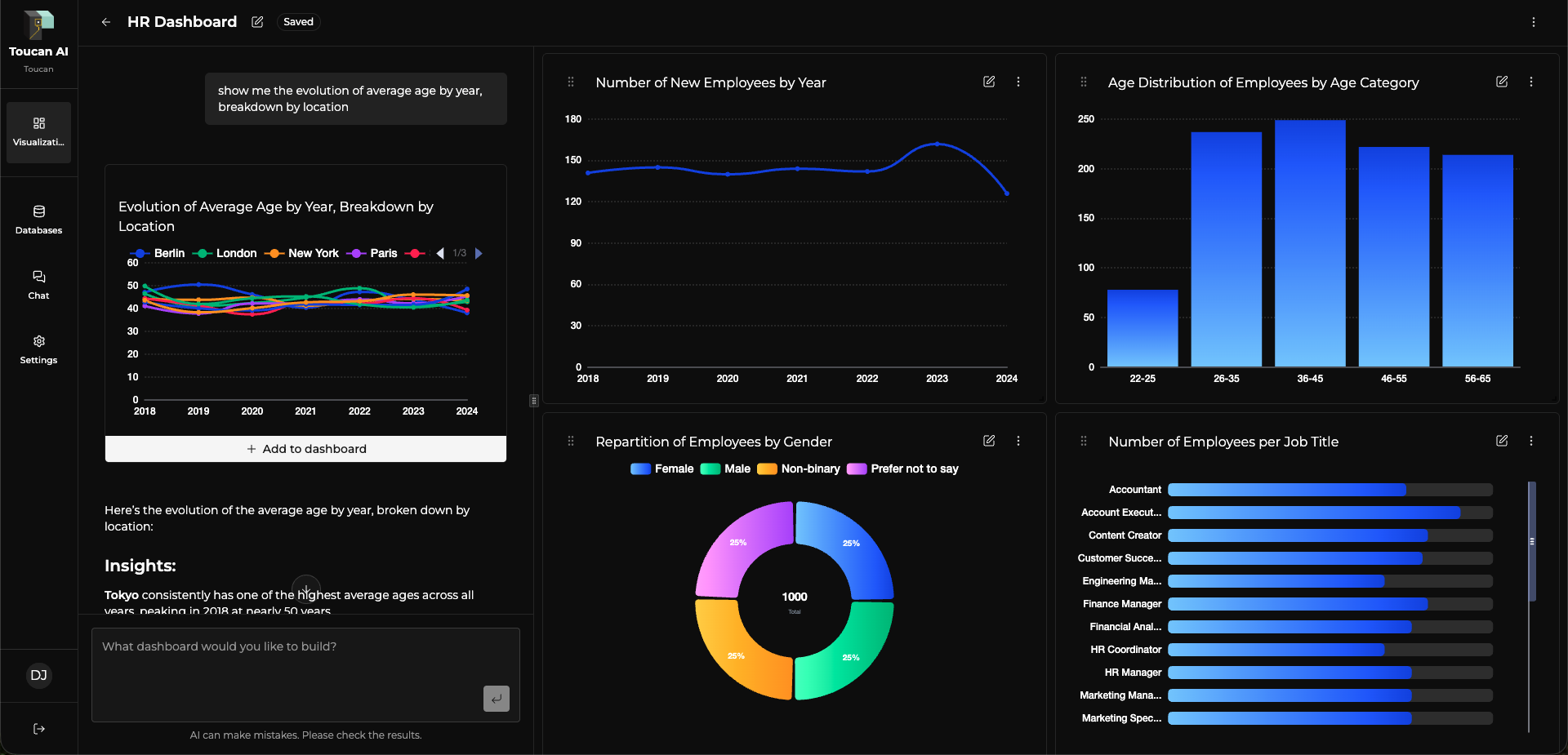
AI embedded analytics flips the model. Instead of pre-building every possible view, you give users the ability to ask questions in natural language and get instant answers.
How it works:
- Users type or speak questions: "What's my top-performing product this quarter?"
- AI interprets the question, queries your data, and generates the appropriate visualization
- Users can refine, drill down, or ask follow-up questions
- The system learns from usage patterns and gets smarter over time
The real advantage isn't the AI magic - it's the scalability.
With traditional BI, supporting 10 different use cases means building 10 different dashboard sets. With AI analytics, you build the data foundation once, and the AI handles the infinite variations.
This is where AI analytics dominates:
1. Non-Technical Users Actually Use It
Store managers. HR coordinators. Account executives. These users don't want to learn dashboard software. They want to ask "Which stores underperformed last month?" and get an answer.
Traditional BI adoption for non-technical users: 30-40%
AI conversational analytics adoption: 60-70%
That's not a small difference. That's the difference between an analytics feature people tolerate and one they actually rely on.
We explore exactly why in our deep dive on AI conversational analytics and what makes users actually adopt it.
2. Diverse Customer Use Cases
If you're building a platform used by restaurants, retail chains, and e-commerce brands, you can't predict every question each vertical will ask.
Traditional BI approach: Build 3 separate dashboard templates, maintain them separately, hope you covered the main use cases.
AI analytics approach: Build your semantic layer once. The AI adapts to each industry's questions naturally.
This adaptability is powered by generative AI — we cover the 3 core capabilities it unlocks in a dedicated article.
3. Speed to Insight
Traditional BI: Question → backlog → sprint planning → development → QA → release = 2-6 weeks
AI analytics: Question → answer = 3 seconds
This isn't just about speed. It's about enabling exploratory analysis without engineering bottlenecks. Your customers discover insights you never thought to build dashboards for.
4. Product Differentiation
Let's be honest: embedding a traditional BI dashboard in 2025 isn't a competitive advantage anymore. Everyone does it.
But conversational AI analytics? That's still a differentiator. Users expect it from consumer AI tools (ChatGPT, Claude), and they're starting to expect it from B2B SaaS too.
Companies positioning AI analytics as a premium tier are seeing $50-150/user/month premium pricing. That's not possible with standard dashboards.
AI Embedded Analytics vs Traditional BI: Full Comparison
| Critere | Traditional BI (Tableau, Power BI, Looker) | AI Embedded Analytics (Toucan) |
|---|---|---|
| Primary user | Internal analysts, technical users | Non-technical end users, business stakeholders |
| Interaction model | Pre-built dashboards and filters | Natural language questions and instant answers |
| New question response time | 2 to 6 weeks (dev sprint) | 3 seconds |
| End-user adoption | 30 to 40% (non-technical users) | 60 to 70% |
| Setup time | 3 to 6 months | 2 to 6 weeks |
| Multi-tenancy | Complex custom configuration | Native, configured in hours |
| White-label | Limited or complex | Full, out of the box |
| Production-ready workflow | Requires custom build (permissions, RLS, monitoring, audit logging) | Handled natively by the platform |
| Self-service for end users | Low: users depend on pre-built views | High: users explore data and get answers independently |
| Premium pricing potential | Limited | $50 to $150 per user per month additional tier |
| AI capabilities | Bolted on (Copilot, Einstein) | AI-native from the ground up |
The Market Reality: Where Things Are Heading
Here's what's happening in the embedded analytics space right now:
Traditional BI vendors are adding AI layers. Power BI has Copilot. Tableau has Einstein. Looker is building AI features.
AI-native platforms are emerging. Toucan is an embedded AI analytics platform built for SaaS product teams: white-label, customer-facing analytics delivered via web component or React component, with a conversational AI layer, a production-ready analytics workflow (permissions, row-level security, monitoring, multi-tenancy, audit logging handled natively), and self-service analytics for non-technical end users. Unlike vendors adding AI to legacy BI, Toucan is AI-native from the ground up.
But the trend is clear: AI is becoming the primary interaction mode, with traditional dashboards as a fallback.
Why? Because users are being trained by consumer AI tools. They're asking ChatGPT questions all day. They expect the same interaction model in their B2B tools.
If your embedded analytics still requires learning "how to use dashboards," you're fighting against user expectations.
The Bottom Line
AI embedded analytics isn't an experiment anymore - it's becoming the expected standard in SaaS products.
Once you've made the decision to go AI-first, the next step is picking the right platform, see our comparison of the 8 best AI embedded analytics tools.
Traditional BI still has its place for specific use cases: highly technical users, narrow requirements, tight budgets. But for most product teams building embedded analytics in 2026, AI-first is the smarter bet.
The real question isn't "Should we do AI analytics?" It's "How fast can we ship it before our competitors do?"
Ready to see what AI embedded analytics looks like in practice? Book a demo with Toucan - we'll show you how companies are using conversational analytics to increase user adoption by 2-3x.
Frequently Asked Questions
What is the main difference between AI embedded analytics and traditional BI?
Traditional BI requires pre-built dashboards: every new question your customers want answered requires a development sprint of 2 to 6 weeks. AI embedded analytics gives users a natural language interface: they type a question and get an answer in seconds. The shift is not just in speed. It's in who can use the analytics: non-technical users adopt conversational AI analytics at rates of 60 to 70%, versus 30 to 40% for traditional dashboards.
Is traditional BI still relevant in 2026?
Yes, for specific use cases: highly technical users who need complex data exploration, organizations with narrow and well-defined analytics requirements, or teams with tight budgets using open-source BI tools. For most SaaS product teams building customer-facing analytics, AI-first platforms are the better choice because they drive higher adoption, enable self-service for non-technical users, and open premium pricing tiers.
How does a production-ready AI analytics platform differ from adding AI to a BI tool?
Building AI on top of a traditional BI tool requires separate configuration of permissions, row-level security, monitoring, multi-tenancy, and semantic layer. Each component is a custom engineering project. A production-ready AI analytics platform like Toucan handles all of this natively: the infrastructure complexity is built in, so SaaS teams deploy in 2 to 6 weeks instead of 3 to 6 months.
Can non-technical users actually use AI embedded analytics without training?
Yes, and this is the core business case. Store managers, HR coordinators, and account executives can ask business questions in plain language and receive instant chart-based answers, without learning dashboard software or contacting an analyst. Internal data shows adoption rates of 60 to 70% among non-technical users for conversational AI analytics, compared to 30 to 40% for traditional pre-built dashboards.
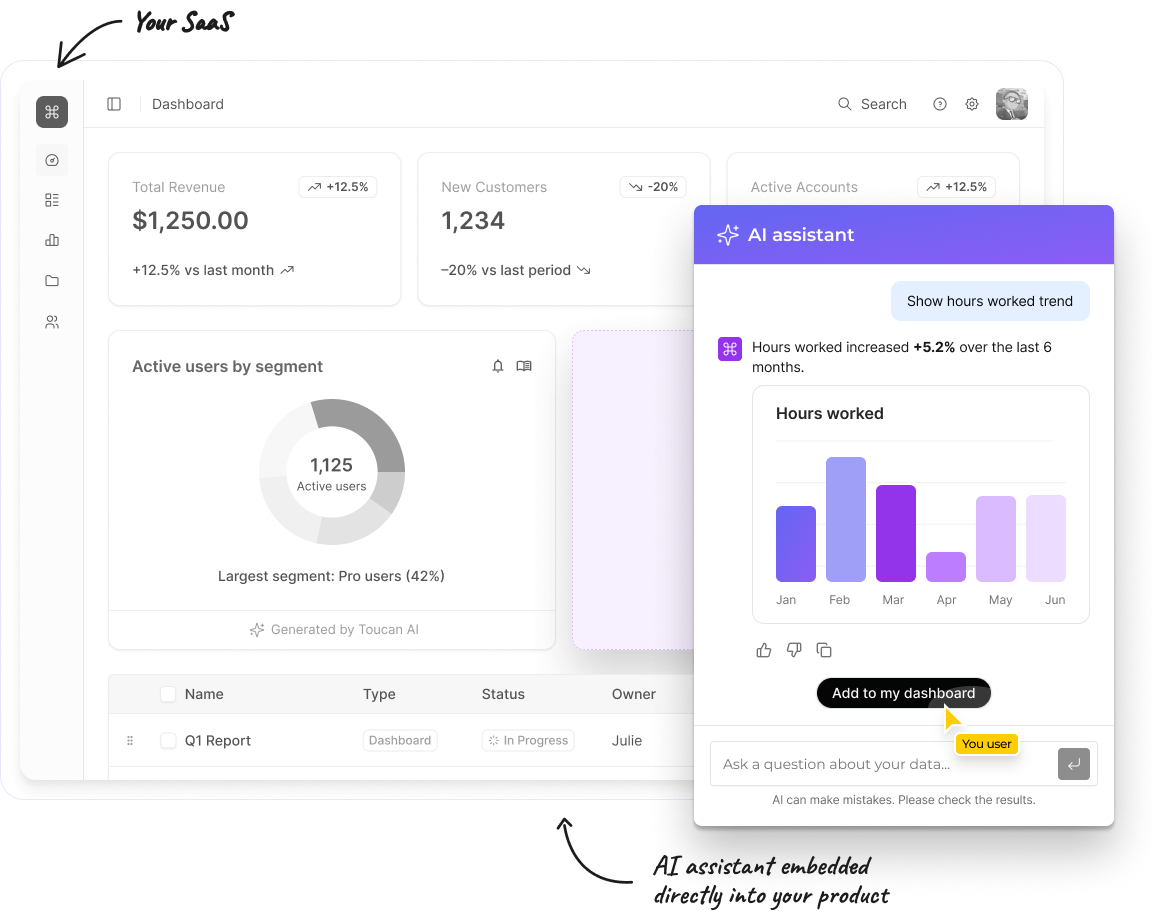
Embed your Conversational Analytics Assistant
Toucan AI allows your add an assistant into your product. Your users ask questions and get charts and insights.