AI Embedded Analytics for SaaS: Complete 2026 Guide

Alim Goulamhoussen
Publié le 09.02.26
Mis à jour le 17.04.26
11 min
Embedded analytics is entering a new era. The dashboards you've been embedding in your SaaS application are about to get a lot smarter, and your end users are expecting it.
Traditional embedded analytics gave your customers static dashboards and pre-built reports. Now they want to ask questions in plain text and get instant answers. They want the system to tell them what's important before they even ask.
This shift isn't optional anymore. Your competitors are already adding AI to their embedded analytics, and your customers are noticing.
The question isn't whether to add AI capabilities, but how to do it without compromising security, blowing your budget, or spending two years building it yourself.
Key takeaways
- AI embedded analytics goes beyond dashboards: end users ask questions in natural language and get instant answers, without SQL knowledge or analyst support. Adoption rates reach 60 to 70% among non-technical users, versus 30 to 40% for traditional pre-built dashboards.
- Multi-tenant security is the make-or-break requirement for SaaS products: tenant isolation must be enforced at every layer (semantic layer, query generation, white-label interface), not just in the front-end.
- The build vs buy threshold is clear: build only if AI analytics is your core product differentiator and you can commit an ML team for 18 to 24 months and over $2M. Otherwise, a platform delivers the same capabilities in 4 to 8 weeks.
- A production-ready analytics workflow covers more than charts: permissions, row-level security, monitoring, multi-tenancy, and audit logging all need to be handled natively. Building each component separately is where most in-house projects underestimate scope and cost.
- Self-service is the business outcome: when end users can explore data independently and get answers without opening a ticket, support load drops, product engagement rises, and premium tier pricing becomes defensible.
What is AI-Powered Embedded Analytics?
Embedded analytics means the dashboards and reports you've integrated directly into your SaaS application. Your customers see them as part of your product, not as a separate BI tool they have to log into separately.
AI-powered embedded analytics adds a layer of intelligence on top of those dashboards. Instead of just displaying charts, your embedded analytics can now understand natural language questions, generate insights automatically, and make predictions based on historical patterns.
The key difference from traditional business intelligence tools is the context. AI embedded analytics needs to work in a multi-tenant environment where hundreds or thousands of your customers are using the same system but should never see each other's data.
It needs to be completely white-labeled so it feels like your product, not a third-party tool.
To compare platforms side by side, see our roundup of the best AI embedded analytics tools.
How AI Works in Multi-Tenant Applications
This is where embedded AI analytics gets complicated, and it's an aspect most vendors gloss over in their marketing materials.
When you're building embedded analytics for a SaaS application, you're not dealing with a single database that everyone queries. You have hundreds or thousands of tenants, each with their own data that must remain completely isolated.
Tenant A should never see Tenant B's metrics, even accidentally.
The Architecture Layers
The semantic layer sits at the foundation. This is where you define what "average order value" means for your specific business domain, which tables contain order data, and how different metrics relate to each other. Critically, this layer also encodes tenant context. Every metric definition includes rules about which tenant's data should be queried.
The natural language processing layer translates plain English into structured queries. But it doesn't just convert "show me revenue" into a SQL statement. It first validates who's asking, which tenant they belong to, and what data they're allowed to access.
Query generation happens next. The AI creates the SQL or API calls needed to answer the question, but it automatically injects tenant filters and permission checks. A user from Tenant A asking about revenue gets a query with "WHERE tenant_id = A" baked in. The tenant context is never optional.
The white-label interface layer ensures your customers never see someone else's branding. The conversational AI uses your terminology, matches your visual design, and refers to metrics using the names you've defined.
Security and Governance
Security becomes even more critical when AI generates queries automatically. You need comprehensive audit trails showing which user asked which question, what query was generated, and what data was returned.
The hallucination problem also requires special attention. AI models sometimes generate plausible-sounding but incorrect information. In embedded analytics, you prevent this by grounding every AI response strictly in your semantic layer.
If a user asks about a metric that doesn't exist, the AI should say "I don't have data on that" rather than inventing an answer.
Key AI Capabilities for Embedded Analytics
Conversational Analytics
Conversational analytics is usually the starting point because it delivers immediate value. Users just type their question instead of navigating through menus and dropdown filters.
"Show me customers at churn risk" generates a dashboard automatically. "Why did revenue drop last week?" triggers an analysis that identifies the contributing factors. The underlying technology is natural language query — and how well it handles ambiguity makes all the difference.
One financial SaaS company reduced custom report requests by 60% after adding conversational analytics. Users who previously submitted tickets asking for specific reports could now get answers instantly.
For a full breakdown of how this works in embedded products, see our guide to AI conversational analytics.
AI-Generated Dashboards
When a new customer signs up for your SaaS product, the system can automatically create a personalized dashboard based on their industry, role, and available data.
A CFO gets financial metrics, a sales manager gets pipeline analytics, and a customer success lead gets retention dashboards.
This dramatically accelerates customer onboarding. Instead of spending three weeks configuring dashboards for each new customer, you can activate them in three days.
Proactive Insights and Anomaly Detection
Instead of users having to check dashboards regularly to spot problems, the system actively monitors for unusual patterns and sends alerts.
"Revenue in EMEA dropped 15% compared to forecast" arrives as a notification with a link to investigate further. The AI detected the anomaly, calculated the variance, and generated an explanation of which specific customer segments drove the decline.
This capability is particularly valuable for executive-level users who don't have time to dig through detailed dashboards daily.
Predictive Analytics Integration
Predictive analytics adds forward-looking capabilities to your embedded dashboards. Instead of only showing what happened, you can show what's likely to happen next.
Churn prediction identifies which customers are at risk of canceling. Demand forecasting helps inventory-based businesses plan for seasonal fluctuations. Sales pipeline forecasting gives revenue teams confidence in their quarterly projections.
The embedding context matters because predictions need to be actionable within your application's workflow. The embedded analytics should link to whatever action the user can take next.
AI in Embedded Analytics by Industry
Fintech and banking embed fraud detection alerts that analyze transaction patterns in real time and personalized investment recommendations that appear in customer portals.
Healthcare SaaS platforms embed patient outcome predictions that help clinicians identify high-risk patients and resource optimization dashboards for hospital administrators.
HR tech applications embed attrition prediction models that identify flight risk employees and talent matching recommendations for recruiters.
E-commerce platforms embed demand forecasting for inventory planning and dynamic pricing insights based on competitor pricing and demand elasticity.
Supply chain applications embed delivery delay predictions and inventory optimization recommendations that balance carrying costs against stockout risks.
Build vs Buy: AI Embedded Analytics Decision Framework
Every SaaS product team eventually faces this question: should we build AI analytics capabilities in-house or embed a third-party platform?
.png?width=624&height=612&name=AI%20in%20Embedded%20Analytics_%202025%20Guide%20for%20ISVs%20-%20visual%20selection%20(1).png)
Building In-House
Building in-house gives you complete control over the AI models, the user experience, and how everything integrates with your existing data architecture.
The reality check comes when you look at timelines and costs:
- Timeline: 18 to 24 months from scratch
- Team needed: ML engineers, data scientists, specialized frontend developers
- Cost: Typically exceeds $2M for the first version
- Ongoing: Infrastructure for training and serving models, continuous maintenance
Building makes sense in exactly one scenario: when AI analytics is your core product differentiator. If you're positioning your SaaS as "the most intelligent platform" in your category, building gives you the competitive moat you need.
Buying or Embedding a Platform
Buying means integrating a third-party solution that handles the AI infrastructure, model training, and interface components.
The advantages are clear:
- Timeline: 4 to 8 weeks for most integrations
- Cost: $30K to $150K per year depending on volume
- Immediate access: Conversational analytics and AI insights without building
- Predictable: Known costs, proven technology
The tradeoff is less control. You depend on the vendor's roadmap for new features.
Key Decision Questions
If you answered "No" or "Maybe" to most questions, buying a platform is likely the better path.
How to Choose an AI Embedded Analytics Platform
Multi-Tenant Architecture
This is non-negotiable for SaaS teams. The platform needs native multi-tenant support, not a single-tenant architecture with workarounds bolted on top.
Ask potential vendors:
- How do you handle tenant isolation at the database level?
- What happens if a query accidentally omits the tenant filter?
- Can different tenants have different metric definitions?
- How does the platform scale from 10 to 10,000 tenants?
White-Label Capabilities
Your customers should never know they're using a third-party analytics tool. Look for complete removal of vendor branding, custom interface styling that matches your design system, and terminology customization so the AI uses your business vocabulary.
AI Capabilities Breadth
Evaluate what AI features the platform actually offers versus what's marketing fluff. Do they support conversational analytics, auto-generated dashboards, anomaly detection, and predictive analytics? Or is it just descriptive reporting with a chatbot?
Developer Experience
Look for comprehensive APIs, SDKs in the languages your team uses, clear documentation, and reasonable time to first integration. If vendors can't tell you average integration time or the number is measured in months, that's a red flag.
Pricing Transparency
Understand whether pricing is per user, per query, per tenant, or some combination. Ask about AI query fees specifically. Some vendors charge extra every time someone uses a conversational feature.
Red flags include vendors who won't show pricing without a sales call and platforms that claim multi-tenant support but clearly weren't designed for it.
Common Challenges and Solutions
.png?width=731&height=486&name=AI%20in%20Embedded%20Analytics_%202025%20Guide%20for%20ISVs%20-%20visual%20selection%20(2).png)
AI Hallucinations
The problem: AI invents plausible-sounding metrics that don't exist in your system.
The solution: Strict semantic layer grounding. The AI should only reference metrics you've explicitly defined. When a user asks about something outside the semantic layer, the AI should respond "I don't have data on that" rather than fabricating an answer.
Multi-Tenant Data Leakage
The problem: Fear that AI might accidentally show Tenant A's data to Tenant B.
The solution: Architecture validation before launch. Run comprehensive security testing with deliberately overlapping data. Implement query logging that captures every AI-generated query with full tenant context.
User Adoption
The problem: Customers' end users don't use the AI features because they're intimidated or don't know what to ask.
The solution: Progressive onboarding with suggested queries. Show example questions relevant to their role. Add tooltips explaining how to phrase questions effectively. Build trust by showing AI insights alongside traditional dashboards initially.
Cost Unpredictability
The problem: AI queries are expensive and costs spiral as usage scales.
The solution: Implement aggressive caching for common queries, optimize AI-generated SQL, and consider usage limits per tenant tier. Monitor unit economics closely.
The Future of AI in Embedded Analytics
AI embedded analytics is evolving rapidly. In the next two to three years, expect agentic analytics that takes actions rather than just providing insights, multimodal queries that accept voice and images, vertical AI models trained for specific industries, and collaborative AI that maintains context across team members.
Toucan: AI-Powered Embedded Analytics Platform
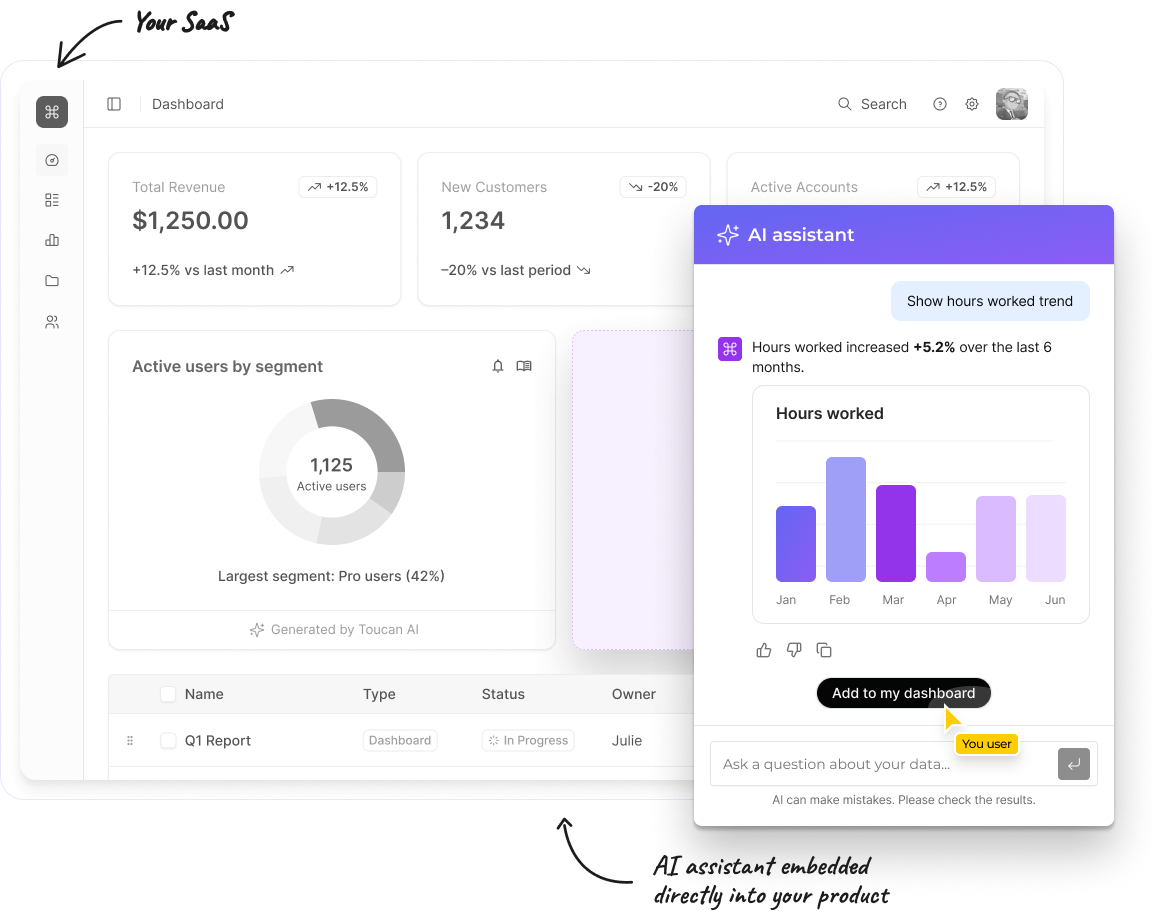
Toucan takes a different approach to AI embedded analytics by combining conversational AI with semantic layer and self-service.
What Makes Toucan Different
Most AI analytics platforms bolt a chatbot onto traditional dashboards. Toucan integrates AI throughout the entire analytics experience. The AI doesn't just answer questions: it delivers a production-ready analytics workflow that handles permissions, row-level security, monitoring, multi-tenancy, and audit logging natively, so SaaS teams ship analytics without building the underlying infrastructure.
Multi-tenant from day one. Toucan was architected specifically for ISVs embedding analytics in multi-tenant SaaS applications. Data isolation is native, not an afterthought. Each tenant can have customized metrics, terminology, and branding.
Complete white-label. Your customers see zero Toucan branding. The interface matches your design system, uses your business vocabulary, and feels like a native part of your product.
Developer-friendly integration. REST APIs and SDKs for React, Angular, and Vue mean most ISVs complete integration in four weeks. The documentation is comprehensive, and the support team includes actual engineers who understand multi-tenant architectures.
Toucan is an embedded AI analytics platform built for SaaS product teams. It delivers white-label, customer-facing analytics via web component or React component, with native multi-tenant row-level security, a production-ready analytics workflow, and self-service analytics for non-technical end users. SaaS teams go from integration to live customer dashboards in couple of days, without permanent engineering overhead after go-live.
G2 reviewers consistently highlight the impact on end-user adoption: "If you want users to quickly get hold of analytics and perceive direct value, Toucan is for you" and "Sharing data with customers is no longer a hassle." Toucan holds a strong rating across 163 verified reviews. [Source: G2 Reviews — https://www.g2.com/products/toucan/reviews]
AI Capabilities
Toucan offers the full range of AI-powered analytics:
- Conversational analytics with natural language queries grounded in your semantic layer
- AI-generated dashboards that adapt to user roles and available data
- Proactive anomaly detection with contextual explanations
- Predictive analytics integration for forecasting and risk scoring
The semantic layer is particularly robust, allowing you to define custom metrics per tenant while maintaining data governance and security.
Conclusion
AI-powered embedded analytics transforms how your SaaS customers interact with data. The technology is mature, the platforms are proven, and your customers are ready for it.
The decision framework is straightforward. Build in-house only if AI analytics is your core differentiator and you can commit an ML team for two years. Otherwise, embed a platform and ship AI capabilities in weeks.
When evaluating platforms, prioritize multi-tenant architecture, white-label capabilities, and pricing transparency. The vendor should understand SaaS product challenges, not just generic BI use cases.
AI embedded analytics is built for multi-tenant SaaS applications where your customers' end users interact with data.
Your customers are already asking for AI features. The question is whether you'll deliver them before your competitors do.
FAQs