Inside Modjo.ai's Agentic Approach - Laurent Billon, Fractional CPO Interview

Alim Goulamhoussen
Publié le 21.01.26
Mis à jour le 24.02.26
6 min
This article is part of our CPO x AI interview series, where we explore how product leaders across the tech industry are integrating artificial intelligence into their products and teams. Today, we're speaking with Laurent Billon about his experience at Modjo.ai.
What does it mean to build a truly AI-native product? Not just adding AI features on top of existing workflows, but rethinking the entire product experience around AI capabilities from the ground up?
Laurent Billon is a Fractional CPO at Modjo.ai, working across two squads + 1 Core AI team, leading 2 Product Managers, 2 Designers, and 1 Product Marketing Manager.
Modjo.ai builds AI agents that capture sales conversations, automates admin tasks (because who actually loves filling-in their CRM manually?), and surface the insights sellers need to win more deals. It's a truly AI-native product where the core experience is built around AI and agentic systems.
We sat down with Laurent to discuss how building AI-first changes everything, from team collaboration to product strategy.
.png?width=1200&height=627&name=blog%20linkedin%20(8).png)
First Impressions
When you first encountered AI in product development, what was your initial reaction, and how did your team approach it?
My first real exposure to AI was quite late, around 2023, when ChatGPT 4 started becoming widely accessible.
At the beginning, only one or two people on the tech side really grasped its potential early on. The rest of us were still figuring out what this technology could actually do beyond the demos and hype.
Personally, for the first few months I almost didn't notice it. I was too focused on "running the business". I tried ChatGPT a bit, but the answers weren't great, and I wasn't sure if we could integrate it in a way that would deliver value for our users. It felt like another tool to experiment with, not a game-changer.
Soon after, when I realized injecting company context and data gave much better answers, I went all-in.
A Shifting Landscape
What specific changes have you seen in your product or team in response to these evolving perceptions?
Once AI started being really integrated into products, that was the turning point where it became a must-have.
At that point, everyone was expected to build their products with AI where it made sense. It wasn't optional anymore.

Use Cases That Actually Matter
Which specific AI use cases have had the most tangible impact on your product or customers?
Definitely knowledge sharing across teams. This might sound boring compared to flashier AI use cases, but the impact has been huge.
For example, when Customer Success has a question, they can ask an agent that searches the whole Notion and returns the relevant answer. When Product has a very deep and precise question on how the product works, we have an agent that can browse the codebase, understand it, and explain what's really in the code.
This reduces the need to duplicate information across knowledge bases. Instead of writing and maintaining a perfect Notion page for every detail, we can query the source of truth directly. It eliminates the constant problem of outdated documentation because you're always pulling from the actual source.
Impact on Delivery
In what ways has AI altered your team's approach to prioritization, testing, and delivery of features?
A very concrete shift happened in the Product Management world.
User stories can be painful: time-consuming, hard to make complete, and corner cases were easy to miss. With AI, writing extremely detailed, “perfect” specifications with all edge cases covered is now essentially free.
I’ve seen many teams respond by producing endless specs to make sure devs build the right thing.
Interestingly, that did not really happen at Modjo (where PMs use AI for just about everything).
Instead, we had really good conversations on "how do we want to work together?". What should we use as specifications: written stories, prototypes, designs, workflow charts? What's the best way to understand each other? When is a conversation better than a document?
When specs became cheap, it became clear that alignment was never really about the docs, but shared understanding of what we want to build.
New Skills, New Expectations
What new roles or skills have become essential within your team?
Because our product is 100% AI, we look for people who have actually built or shaped features with agentic approaches. People who actually understand the core concepts.
At this point, "I've used AI tools and built n8n workflows" isn't enough. We need people who understand what happens under the hood, who can design around the limitations and capabilities of these systems, and who know when an agentic approach is the right solution versus when it's overkill.
The Stack
What does your current product and AI stack look like?
At Modjo.ai, the core system is quite complex. We combine vector, structured, unstructured and graph databases to organize and map knowledge extracted from customer conversations. Each database type serves a specific purpose in how we store and retrieve information.
When new models are released, our Core AI team evaluates their performance with carefully crafted datasets for each of our use cases. If they perform better than the ones we currently use, we upgrade. We use a blend of models, versions and sizes from OpenAI and Google.
At the business level, our AI layer that processes and structures this conversation knowledge, and gives excellent answers and insights based on user queries.
On top of that, we built a UX that blends conversational interfaces and Gen-AI features embedded into traditional SaaS experiences. Users don't think "now I'm using the AI part".
Build vs. Buy
How do you decide between choosing to build in-house or integrate a third-party AI solution?
AI is becoming "normal software." We don't treat it as fundamentally different from other build-vs-buy decisions.
"We build what's core-business and core-vision in-house."
We use opensource solutions and algorithms whenever possible, because there's no point rebuilding what already exists, works well and is maintained by experts in their own domain.
We are very sensitive to data protection issues, and only work with companies that guarantee EU-processing. This is non-negotiable for us, especially given the nature of sales conversations we handle.
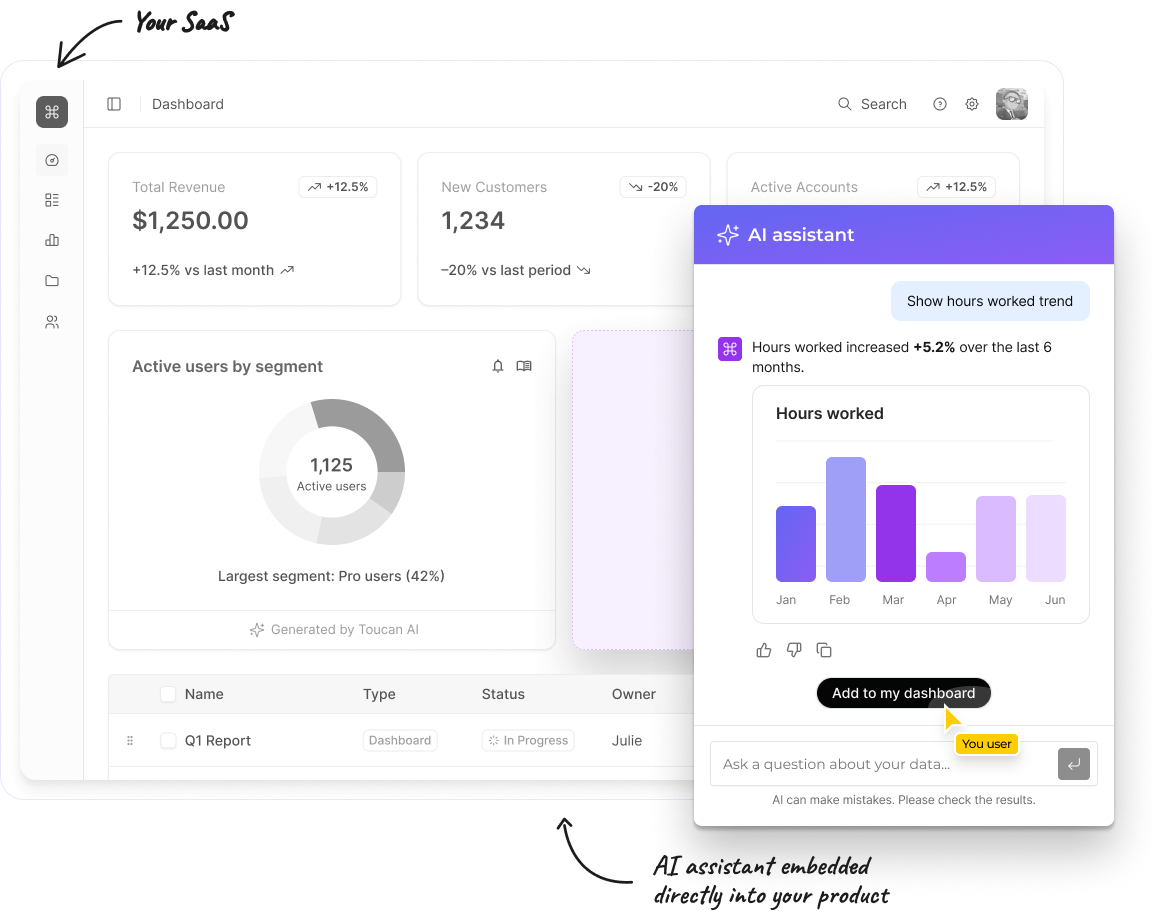
Toucan AI is an AI-native embedded analytics chat built to help SaaS companies integrate analytics directly into their product. With a semantic layer and natural language question-to-chart capabilities, Toucan AI allows customers to easily explore their data and understand what’s happening without needing technical skills by conversing in a chat.
You can request your access :)
Measuring What Matters
What metrics or KPIs do you focus on to measure the ROI and business impact of AI in your product?
Our job is to help salespeople do their jobs 10x better with AI, and to do it in a way that's delightful. We don't settle on anything less than having people use our products every day. If they're not coming back daily, we haven't truly solved their problem.
So our north star metric is DAU, which is not that common for B2B SaaS. Most B2B products are happy with weekly or monthly usage.
Pitfalls to Avoid
From your experience, what are the biggest pitfalls organizations face when adopting AI, and how can they be avoided?
The biggest mistake is treating AI as something you "add-on" to what you already do, as a side project, or a layer on top of an unchanged product. I see this constantly. Companies bolt on a chatbot or an AI feature without rethinking the core experience.
If AI isn't deeply integrated into the product experience, you often end up with a disconnected feature. In many cases, the right move is more radical: clear the roadmap and rethink the product around AI capabilities. This is scary because it means letting go of your existing roadmap, but it's often necessary.
For example: if you build dashboards, it's no longer mainly about charts and graphs. It's about recommendations, prioritization, and AI-generated reports. The dashboard becomes less about visualization and more about intelligence and action.
The Road Ahead
What role will AI play in your product roadmap over the next 2–3 years?
AI is about 90% of our product efforts today, and we expect it to stay the same. We're not diversifying away from AI, we're going deeper.
" The biggest upcoming change will happen when systems truly understand individual users, their team context and their preferences and patterns over time."
Right now, most AI tools treat every session as relatively independent.
At that point, the product will be less about responding to prompts, and much more about delivering on-time, hyper-relevant recommendations proactively. The AI won't wait for you to ask, it will know what you need before you do.
Tool of the Moment
What AI tool or technology has recently impressed you, and why?
AI Videos. I don't understand the tech. I still think there's magic involved.
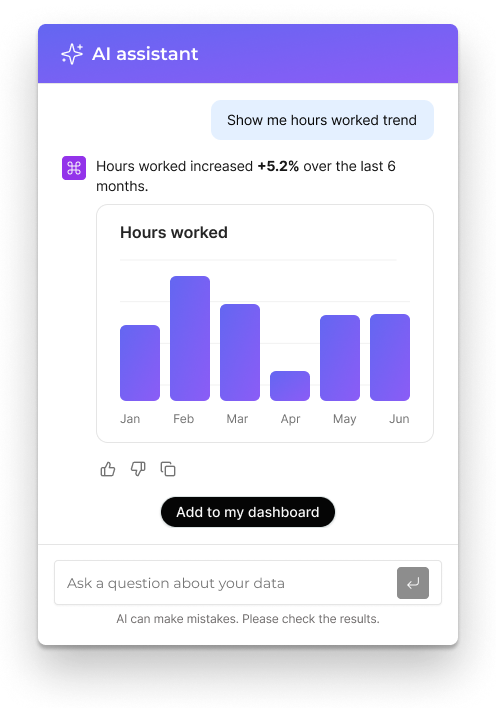
Toucan is an embedded chat powered by AI to ask in plain text your data and get instant charts and insights. Toucan is fully white label to match your brand.
Advice for CPOs
What advice would you give to a CPO beginning their AI journey today?
Build a deep understanding of fundamentals. Learn the core concepts: what a model is, what are the limitations? Learn Context Engineering, RAG, Agentic patterns. Know the trade-offs between cost, latency, and quality.
Everything moves quickly, but these foundations always stay the same. If you master them, you'll be able to understand whatever comes next much more quickly. The specific tools and models will change every few months, but the underlying principles remain constant.
About Toucan AI
Making AI Insights Accessible to Everyone
Toucan AI transforms how business teams interact with their data. Instead of writing SQL queries or waiting days for data team support, users simply ask questions in plain language. "Which customer segments churned most last quarter?" or "What are the top product complaints this month?" and get instant, accurate answers.
Built on your company's existing data sources, Toucan AI makes analytics accessible to product managers, customer success teams, business leaders and customers who need fast answers to drive decisions. No technical training required, no complex dashboards to learn. Just natural conversation with your data.