
How TheyDo Transform Customer Journey with AI - Lucile Cazenave, Product Leader Interview

Alim Goulamhoussen
Publié le 21.01.26
Mis à jour le 17.02.26
4 min
This article is part of our CPO x AI interview series, where we explore how product leaders across the tech industry are integrating artificial intelligence into their products and teams. Today, we're speaking with Lucile Cazenave about her experience at TheyDo.
Lucile Cazenave is a Product Leader in charge of Data & Integrations at TheyDo, where she focuses on turning fragmented customer data into actionable insights.
TheyDo is a customer journey management platform designed to help teams make sense of scattered customer information. By connecting qualitative and quantitative data from sources like support tickets, user interviews, analytics platforms, and feedback forms, TheyDo enables teams to deeply understand customer journeys and make better product decisions.
We sat down with Lucile to discuss how her team is navigating the AI innovation, from embedding AI into their product to transforming internal workflows.
%20(1).png?width=1200&height=627&name=blog%20linkedin%20(4)%20(1).png)
When you first encountered AI in product development, what was your initial reaction, and how did your team approach it?
We're all very curious about AI and have been focused on it for quite some time now as we've embedded AI within our product. Not only do we use it for team efficiency but also to provide value to our customers.
The team's curiosity quickly translated into concrete action. We are obviously looking at faster solutions. We use AI to drive creativity via Lovable or Figma Make or structure our thoughts when brainstorming on new features. Engineers are also leveraging it for QA and development.
Which specific AI use cases have had the most tangible impact on your product or customers?
In our product, AI mining is a core capability that enables customers to create customer journeys and mine insights from raw data like user feedbacks or transcripts, support logs. Customer journeys get continuously enriched and CX teams can visualize where in the journey users struggle the most, and therefore which pains to invest in.
This isn't just a nice-to-have feature. It's solving a real problem that would otherwise require hours of manual analysis, turning fragmented customer data into clear, actionable insights.
In what ways has AI altered your team's approach to prioritization, testing, and delivery of features?
Prototyping and testing has never been so easy! We've really gained in efficiency in this area by being able to show customers solutions we're imagining and getting quick feedback.
Test automations are really helping QA as well. Vibe-coding solutions to unlock customers is also a new thing that we welcome as a fast efficient way to bring satisfaction for very specific needs. It's changed our entire development cycle. We can move from idea to validated prototype much faster than before.
What new roles or skills have become essential within your team?
I've identified three critical competencies that have become essential:
- AI agility: Know when AI is going to be a winning option. It's about understanding when AI is the right solution versus when traditional approaches work better.
- AI mindset: Go to AI naturally and pick/compare the models you know will give the best results for your needs. This becomes second nature over time.
- Informed delegation: Let AI do it for you if you have validated it can. Learning when to let AI handle tasks autonomously versus when human oversight is critical.
We also recently launched a side track for "vibe coding" experiments, recognizing that rapid AI-assisted prototyping is becoming a core skill for our team.
How do you decide between choosing to build in-house or integrate a third-party AI solution?
We have a dedicated AI team that assesses pros and cons of building vs buying. At the product level, we use Figma Make, Lovable, ChatGPT, Claude, Notion AI, Unblocked, Granola AI, Whispr AI, Amplitude, Cursor among others.
It's a strategic decision every time. We evaluate based on our specific needs, the maturity of available solutions, and where we can truly add unique value versus leveraging existing tools.
What metrics or KPIs do you focus on to measure the ROI and business impact of AI in your product?
AI is a vector, not the result. So it contributes to the value of our product just like any other "enabler". Success is measured by adoption and growth of our AI features and also through customer feedback and learnings. ROI and business impacts are measured at journey management level, AI is a part of it.
This perspective keeps us focused on outcomes rather than technology for its own sake. We don't measure "AI success" in isolation. We measure how it contributes to our customers' ability to understand and improve their customer journeys.
From your experience, what are the biggest pitfalls organizations face when adopting AI, and how can they be avoided?
Trusting AI too fast. Wanting to go all on AI without knowing what to expect from it. If you randomly ask AI, chances are you won't get good results. If you feed it badly (data), the same will happen.
The key lesson is quality in, quality out. Organizations need to be thoughtful about how they structure their prompts, how they prepare their data, and what they expect from AI. It's not magic. It's a tool that requires understanding and proper implementation.
What role will AI play in your product roadmap over the next 2–3 years?
Prototyping, vibe-coding are really part of our team's ways of working now so we imagine we'll improve over time and become more and more efficient through it. Cursor will probably bring new nice surprises as well that engineers will play with.
Our own product is pretty impressive already and will most likely improve in the future to let users ask questions about their journeys from our product or elsewhere, share findings and collaborate via agents. The vision is to make customer journey intelligence accessible from anywhere, with AI agents helping teams collaborate and surface insights automatically.
What AI tool or technology has recently impressed you, and why?
Amplitude Agents: these agents, when set up properly, bring great insights into the next action to drive for product improvements.
What impresses me is how they go beyond just analytics. They actually suggest concrete next steps based on the data, which is exactly the kind of actionable intelligence product teams need.
What advice would you give to a CPO beginning their AI journey today?
Try it :) Find the problems that AI can solve for you and leverage AI to test. Join AI communities, discuss it and share good practises and findings with peers.
Don't overthink it, but don't rush it either. Start with real problems, experiment rapidly, and learn from others who are navigating the same journey. The AI landscape is evolving so fast that staying connected with the community is essential.
Making AI Insights Accessible to Everyone
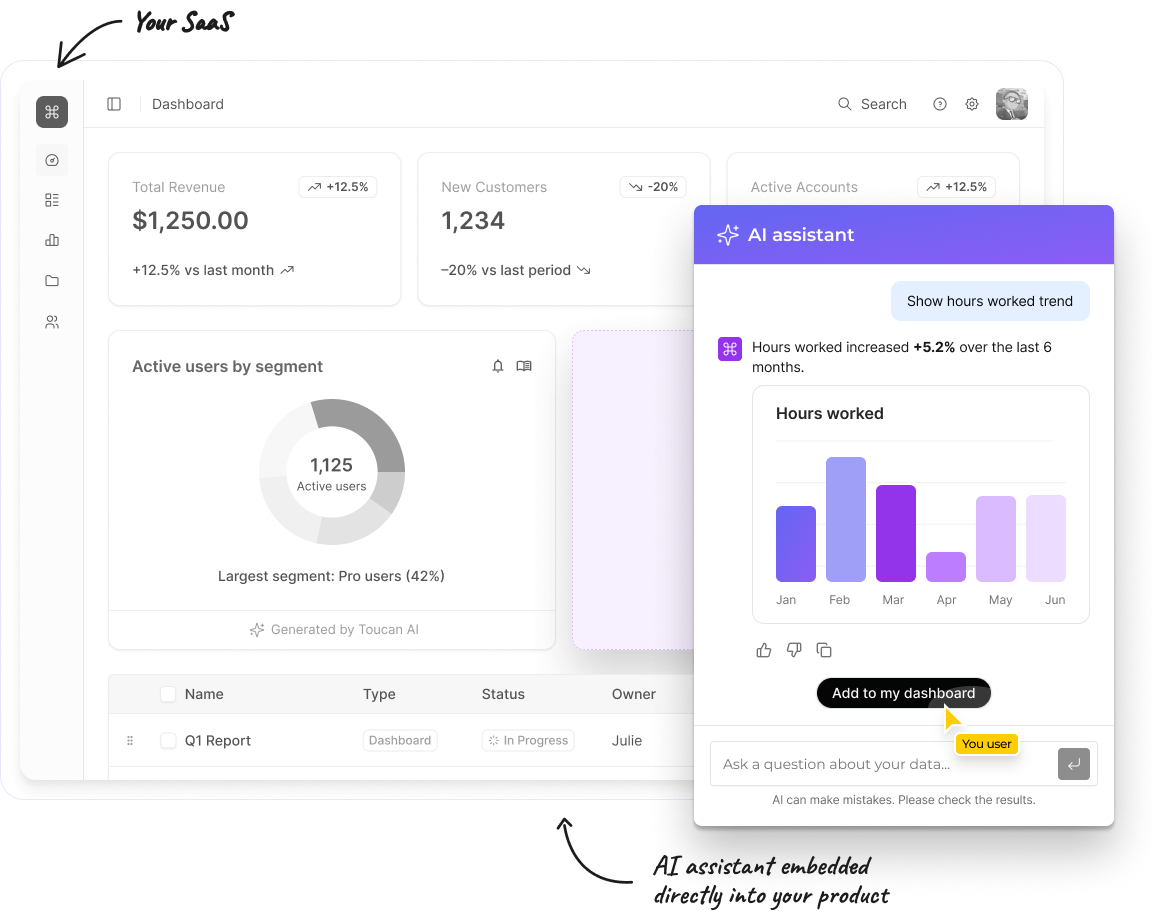
Toucan AI transforms how business teams interact with their data. Instead of writing SQL queries or waiting days for data team support, users simply ask questions in plain language. "Which customer segments churned most last quarter?" or "What are the top product complaints this month?" and get instant, accurate answers.
Built on your company's existing data sources, Toucan AI makes analytics accessible to product managers, customer success teams, business leaders and customers who need fast answers to drive decisions. No technical training required, no complex dashboards to learn. Just natural conversation with your data.