7 Best Metabase Alternatives for Embedded Analytics [2026]

Alim Goulamhoussen
Publié le 24.02.22
Mis à jour le 19.01.26
12 min
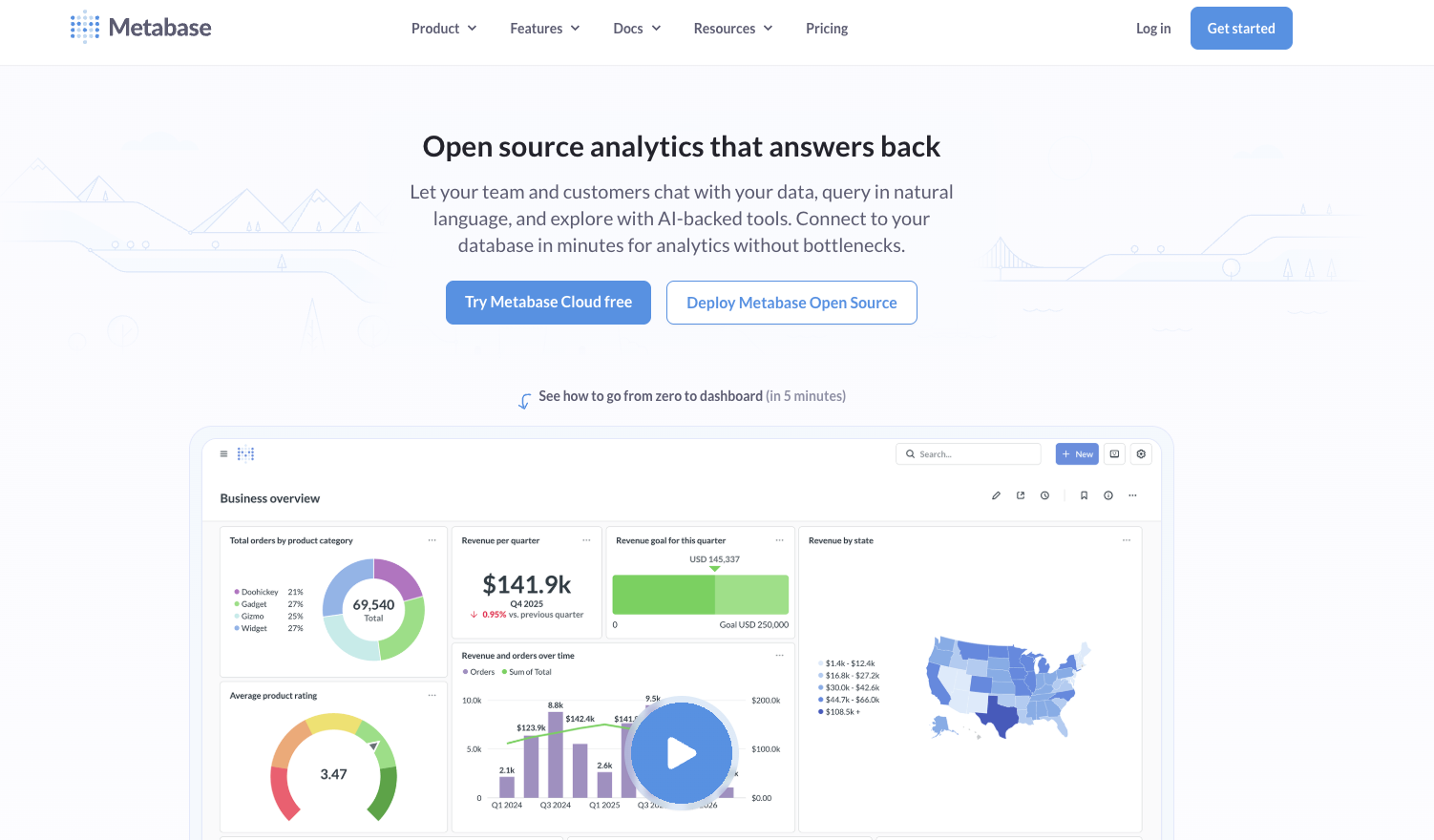
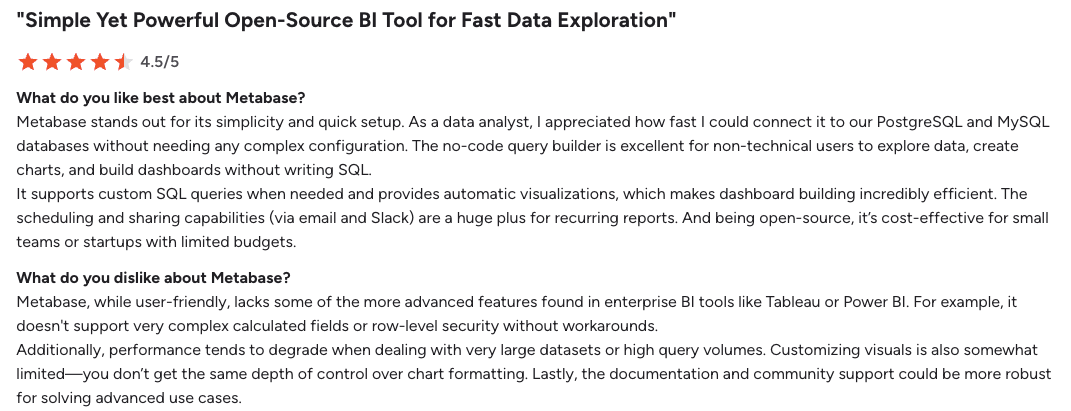
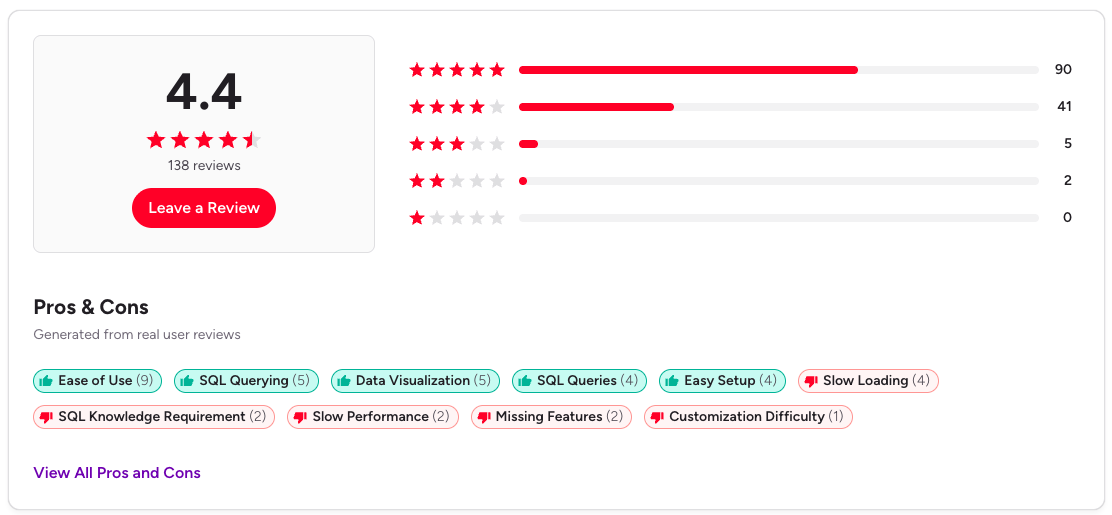
Metabase delivers value as an open-source business intelligence tool, particularly for internal analytics use cases. However, organizations frequently encounter significant limitations when attempting to embed Metabase dashboards into customer-facing applications.
The platform's iframe-only embedding approach, performance constraints with larger datasets, and limited white-labeling capabilities create friction for product teams building embedded analytics experiences. These technical limitations become more pronounced as data volumes increase and user expectations for native-feeling integrations rise.
This analysis examines seven Metabase alternatives based on direct evaluation, implementation experience, and verified customer feedback. Each tool assessment includes transparent pricing information, technical capabilities, and specific use cases where the platform excels or falls short.
The focus is on solutions purpose-built for embedded analytics rather than traditional internal BI tools adapted for embedding.
Why Teams Outgrow Metabase for Embedded Analytics
Metabase functions effectively for internal analytics use cases. However, organizations encounter structural limitations when implementing Metabase for customer-facing embedded analytics scenarios.
Based on evaluation experience and feedback from teams who have migrated from Metabase, five technical constraints consistently emerge:
1. Iframe Embedding Means Your Analytics Never Feel Native
Metabase only offers iframe embedding. That's it. No native React components, no SDK, just iframes. What does that actually mean?
Your embedded dashboard will always have that "bolted-on" feel. The font won't quite match your app. Dark mode? Forget about it—the iframe stays light even when your app goes dark. Load times are slower because you're loading an entirely separate application inside yours.
One team told us their customer support tickets spiked after they launched embedded Metabase dashboards. Why? Users thought the analytics were broken because they looked so different from the rest of the app. Turns out they worked fine—they just didn't feel like they belonged.
2. Query Performance Degrades Fast with Real Data
Metabase's caching is rudimentary at best. We tested it with a modest dataset—about 2 million rows across a few tables. Simple aggregations? Fine. But the moment you start joining tables or running slightly complex queries, you're waiting. And waiting.
The problem gets worse with multiple concurrent users. Five people hitting the same dashboard at once? Slowdowns. Twenty? Timeouts. There's no native query result caching that actually scales, and the database connection pooling maxes out faster than you'd expect.
According to Apache Superset's documentation, their caching layer was specifically designed to handle this exact problem that Metabase struggles with.
3. "No SQL Required" Only Works for Trivial Queries
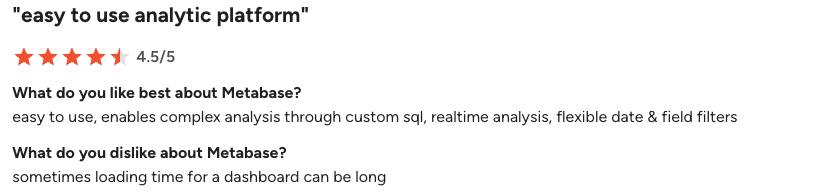
Metabase's query builder is decent for "show me sales by month" or "count of users by region." But the moment you need:
- Window functions
- Subqueries
- Complex joins with conditional logic
- Custom aggregations
...you're writing raw SQL. Which defeats the entire purpose of having a no-code BI tool. Your business users are back to filing tickets with the data team, and you're back to being a bottleneck.
4. Multi-Tenant Security Is a Patchwork
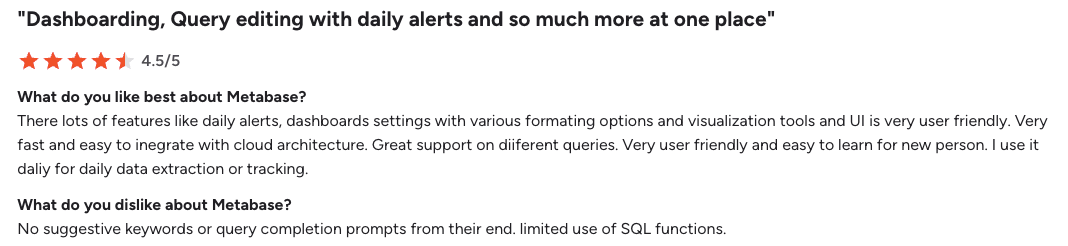
If you're embedding analytics for multiple customers (aka multi-tenancy), you need rock-solid row-level security. Each customer should only see their own data, period.
Metabase's approach requires cobbling together user attributes, SQL snippets in your queries, and hoping you didn't miss an edge case. There's no native RLS (row-level security) framework. Most teams end up building a custom middleware layer just to make multi-tenant embedding secure.
As Toucan's security documentation points out, proper embedded analytics requires "granular access controls at the row level with built-in token management"—something Metabase doesn't offer out of the box.
5. Self-Hosting Has Hidden Costs
Yes, Metabase is open-source and technically free. But let's be real about the actual cost:
- Infrastructure: Hosting, load balancing, backups
- Maintenance: Security patches, upgrades, debugging when things break
- Monitoring: Making sure it stays up
- Scaling: Adding resources as usage grows
One engineer we spoke with estimated 15-20 hours per month just keeping their self-hosted Metabase instance running. At a $75/hour average engineering rate, that's $1,125-$1,500/month—suddenly that "free" tool isn't looking so cheap.
Metabase Cloud exists, but at that point you're paying for a hosted version that still has all the other limitations.
The 7 Best Metabase Alternatives
Toucan – Best for Customer-Facing Embedded Analytics with AI
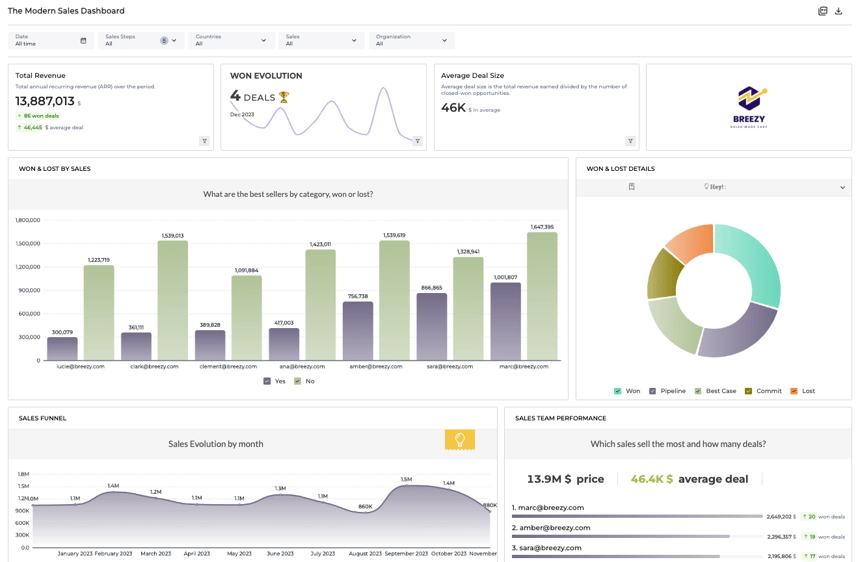
Why it stands out: Toucan differentiates itself through exclusive focus on embedded analytics rather than serving dual internal BI and embedded use cases. The platform's AI-powered natural language capabilities and purpose-built embedding architecture address specific friction points in customer-facing analytics deployments.
Purpose-Built for Embedding
Unlike platforms adapted from internal business intelligence tools, Toucan's architecture prioritizes embedded analytics requirements from the ground up. This focus manifests in native white-labeling capabilities, comprehensive security controls at the row level, and deployment workflows optimized for multi-tenant SaaS environments.
AI-Powered Data Exploration
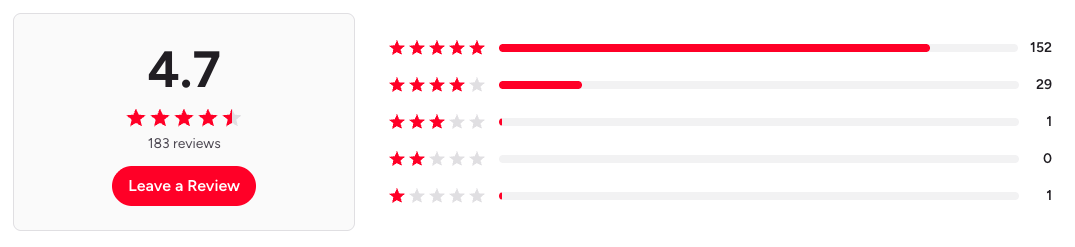
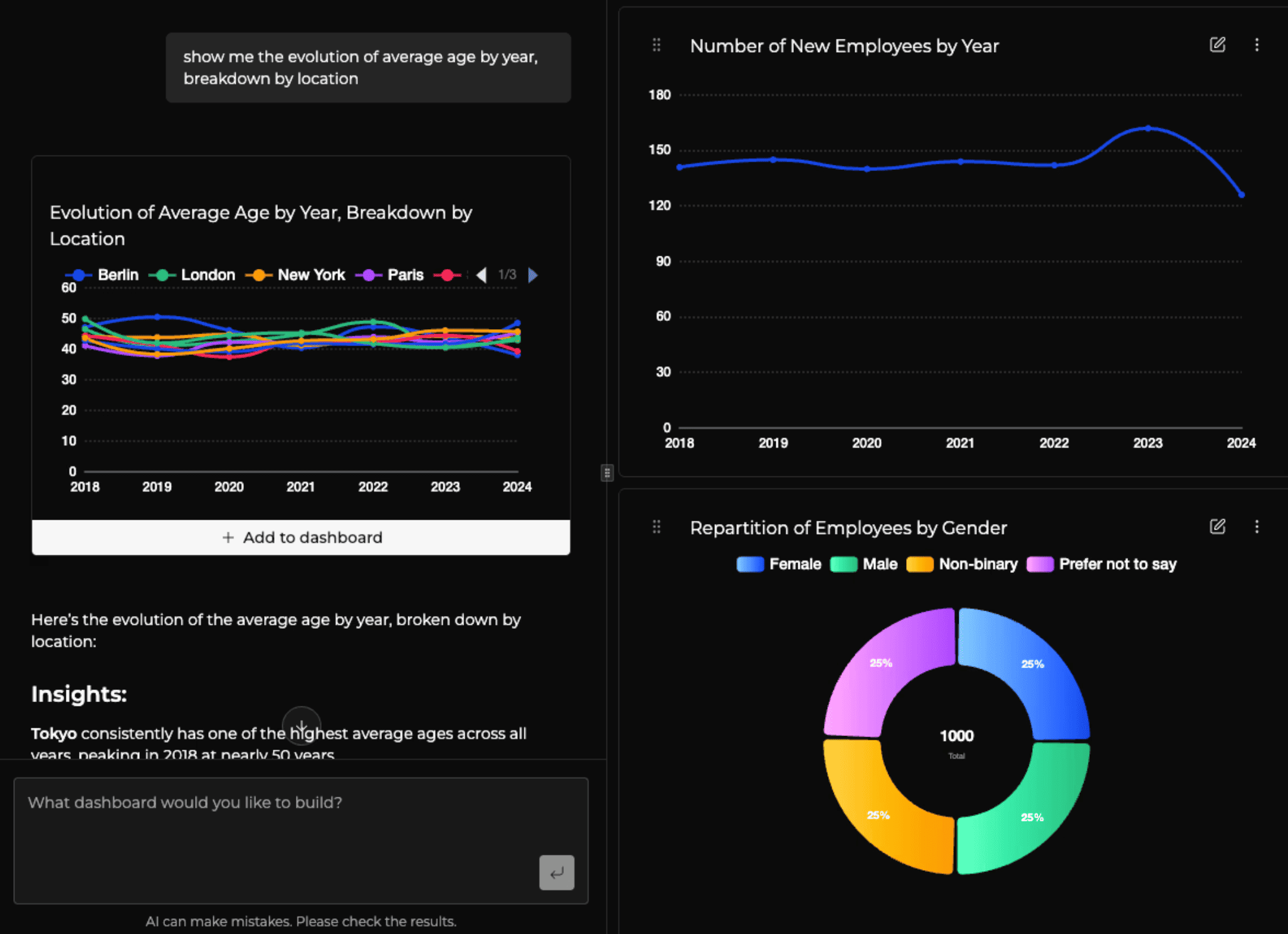
The platform's AI capabilities extend beyond basic chatbot implementations. End users can query data using natural language and receive contextually relevant insights without understanding underlying table structures, join relationships, or query languages.
This approach significantly reduces training requirements and support overhead. According to customer reports, organizations implementing Toucan's AI-driven exploration experience 40-60% reduction in analytics-related support tickets compared to traditional query-based interfaces.
Key technical capabilities:
- Natural language querying: End users ask questions in plain language; the AI interprets intent and generates appropriate queries
- No-code environment: Product teams connect data sources, design dashboards, and deploy without writing SQL or learning proprietary query languages
- Native connectors: 100+ pre-built integrations with modern data warehouses (Snowflake, BigQuery, Redshift) and databases
- Multi-tenant security: Row-level security with built-in token management ensures proper data isolation across customers
White-Labeling and Brand Control
Complete branding control extends across all dashboard elements—colors, fonts, layouts, and UI components. Embedded dashboards function as native extensions of the host application rather than visibly third-party integrations.
The embedding SDK provides programmatic control over authentication, navigation, and event handling, enabling deep integration with existing application workflows.
Implementation Velocity
Customer implementations typically achieve production deployment within 2-4 weeks. The no-code workflow eliminates dependencies on specialized technical resources while maintaining the sophistication required for complex analytical use cases.
Real-World Application
A B2B SaaS platform serving financial services embedded Toucan to provide portfolio analytics to end clients. The AI-powered querying reduced time-to-insight from an average of 12 minutes to under 90 seconds, with corresponding improvement in feature engagement metrics.
Pros
✅ Purpose-built for embedded analytics rather than adapted from internal BI
✅ AI-powered natural language queries reduce training and support overhead
✅ Native white-labeling with complete brand control
✅ Rapid deployment timeline (typically 2-4 weeks to production)
✅ Comprehensive row-level security for multi-tenant architectures
Cons
❌ Custom pricing model may present budget challenges for early-stage organizations
❌ Less suitable for teams requiring complete low-level customization
❌ Newer platform compared to established enterprise BI vendors
Pricing
Custom pricing based on deployment scope and user volume. Toucan's pricing model accounts for two primary ROI drivers in embedded analytics: reduced engineering overhead and revenue generation through analytics offerings.
The platform typically demonstrates positive ROI through combination of eliminated custom development costs and increased customer retention attributed to embedded analytics capabilities.
Best for: B2B SaaS companies embedding customer-facing analytics, product teams seeking alternatives to complex internal BI platforms, organizations requiring AI-powered insights without custom development.
Documentation: Toucan embedding architecture provides technical implementation details.
Preset.io – Best for Managed Apache Superset
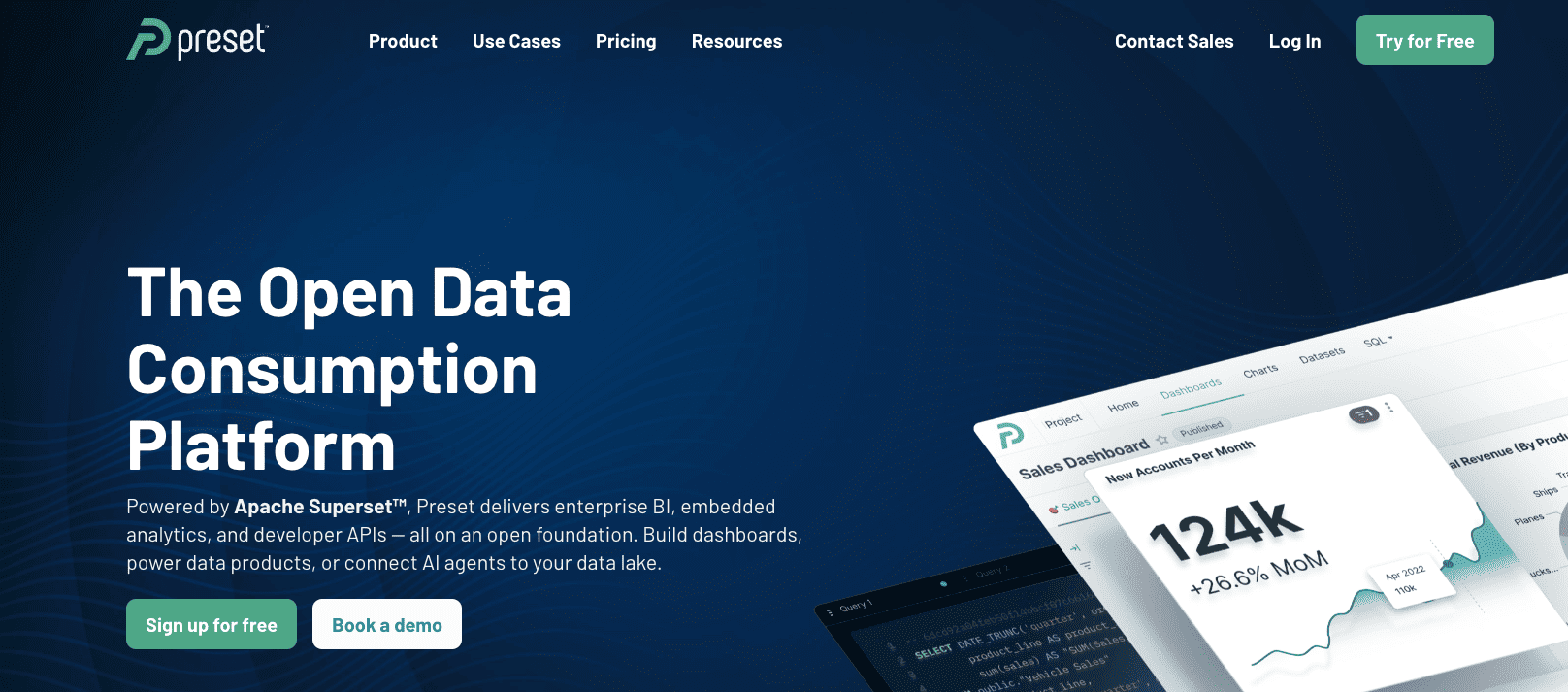
Why it stands out: Preset is basically Apache Superset without the operational headache. You get all of Superset's power (and there's a lot), but someone else handles the infrastructure, updates, and scaling.
What You're Getting
Preset runs on top of Apache Superset—one of the most popular open-source BI tools out there. Superset has over 60,000 GitHub stars and powers analytics at companies like Airbnb, Netflix, and Twitter.
The difference? With Preset, you're not managing servers, debugging config files, or worrying about security patches.
Key features:
- Advanced SQL capabilities: Full SQL IDE with syntax highlighting and autocomplete
- 50+ chart types: From basic line charts to complex geospatial visualizations
- Semantic layer: Define metrics once, reuse everywhere
- Cloud-native: Scales automatically with your data
Real Talk on Preset vs Self-Hosted Superset
If you're technical and have DevOps resources, self-hosting Superset is free. But realistically? You're looking at 10-20 hours a month on maintenance. Preset's pricing starts to make sense when you factor in engineering time.
That said, Preset's embedding story is... complicated. It works, but you'll need developer resources to implement it properly. This isn't a "copy-paste an embed code" situation.
Pros
✅ All the power of Superset without the operational overhead
✅ Actually scales to enterprise data volumes
✅ SQL-native for technical teams
✅ 14-day free trial to test it out
Cons
❌ Steep learning curve for non-technical users
❌ Embedding requires significant dev work
❌ Can get expensive fast ($20/user/month adds up)
Pricing
- Starter: Free for up to 5 users
- Professional: $20/user/month (billed annually)
- Enterprise: Custom pricing
Note: Embedded dashboards cost extra—starting at $500/month for 50 viewer licenses.
Best for: Technical teams comfortable with SQL who want enterprise-grade analytics without managing infrastructure.
Lightdash – Best for dbt Users
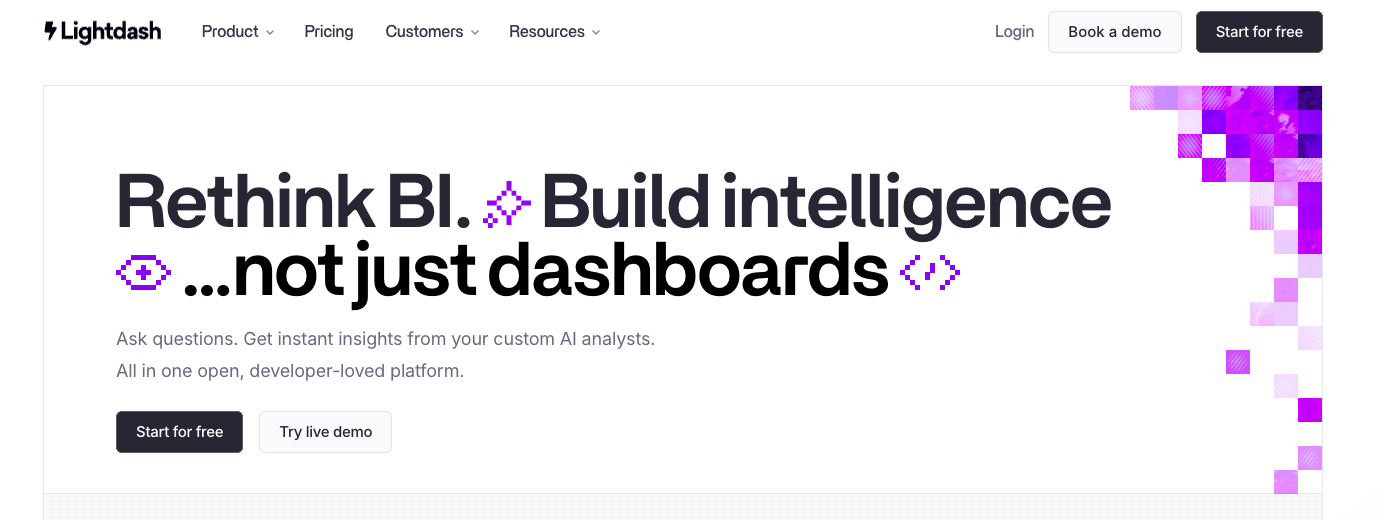
Why it stands out: If your data team is already using dbt (data build tool), Lightdash is the obvious choice. It's built specifically to work with dbt models, which means your metrics definitions stay in sync automatically.
The dbt Integration Advantage
Here's why this matters: with most BI tools, your data team defines logic in dbt, then has to recreate that same logic again in the BI tool. That's double the work and double the chance for things to break.
Lightdash connects directly to your dbt models. Define a metric once in dbt, and it's instantly available in Lightdash. No translation layer, no drift between systems.
Key features:
- Native dbt sync: Metrics, dimensions, and tests flow directly from dbt
- Git-based workflow: Changes to dbt automatically update dashboards
- Self-service for business users: Non-technical folks can explore data using the metrics data teams defined
- SQL auto-generation: Business users build queries visually, Lightdash writes the SQL
Where It Falls Short
Lightdash is great for exploration and analysis, but the visualization options are basic compared to something like Tableau. If you need fancy charts or heavy customization, you might be disappointed.
Also, embedding is possible but clearly not the primary use case. The docs exist, but you're on your own more than with purpose-built embedded analytics tools.
Pros
✅ Perfect for dbt-first organizations
✅ Single source of truth for metrics
✅ Open-source with a managed cloud option
✅ Version control built in
Cons
❌ Requires dbt knowledge to get full value
❌ Limited visualization customization
❌ Embedding isn't the strong suit
Pricing
- Cloud Starter: $800/month
- Cloud Pro: $2,400/month
- Self-hosted: Free (with optional paid support)
Best for: Data teams already using dbt who want to democratize access to trusted metrics.
Holistics – Best for Automated Reporting & Data Teams
Why it stands out: Holistics takes a different approach—it's built around the idea that your BI layer should be managed like code. Everything lives in Git, CI/CD pipelines test changes, and your data team can actually maintain analytics at scale.
The Git-Native Advantage
This sounds nerdy (because it is), but it solves a real problem. Ever had someone break a dashboard and you have no idea what changed? With Holistics, every change is tracked in Git. You can review changes before they go live, roll back mistakes, and maintain a proper audit trail.
Key features:
- Git-based data modeling: Treat your BI layer like software (version control, code review, rollbacks)
- Automated data pipelines: Schedule reports and dashboards to run and deliver automatically
- Self-service with guardrails: Business users can build reports, but within boundaries data teams define
- Strong embedding: White-label dashboards with full API control
Who Actually Uses This?
Holistics is popular with fast-growing SaaS companies that have outgrown simpler tools but don't want the complexity of enterprise platforms. The Git workflow resonates with developer-heavy teams who want to apply software engineering practices to analytics.
Pros
✅ Git-native workflows (version control, CI/CD)
✅ Strong automated reporting capabilities
✅ Good embedding with white-label options
✅ Scales well for mid-market companies
Cons
❌ Steeper learning curve than no-code tools
❌ Requires data modeling knowledge to set up properly
❌ Not ideal for real-time use cases
Pricing
- Entry Plan: $800/month
- Standard Plan: $1,000/month
- Security Compliance Suite: $2,000/month
Best for: Data teams that want to manage BI infrastructure like software, with proper version control and automated testing.
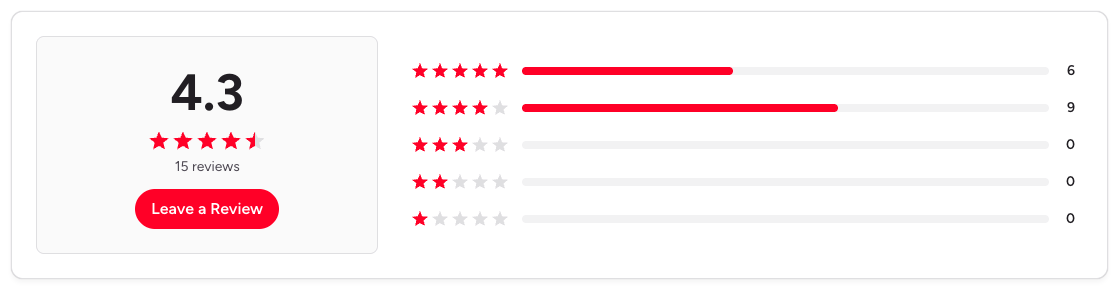
Apache Superset – Best Open-Source Alternative
Why it stands out: Superset is what people usually mean when they say "open-source alternative to Tableau." It's Apache Software Foundation's data visualization project, which means it's genuinely free, community-driven, and not going anywhere.
What Makes Superset Powerful
Superset was built at Airbnb to handle massive data volumes and give technical teams full control. It's not dumbed down—you get advanced SQL editing, custom visualizations, and the ability to modify literally anything.
Key features:
- Truly open-source: Apache 2.0 license, no vendor lock-in
- 50+ visualization types: Line charts to geospatial maps
- SQL Lab: Full IDE for complex queries
- Extensible: Build custom plugins and visualizations
- Database support: Connects to basically any SQL database
The Self-Hosting Reality Check
Here's what the marketing material won't tell you: self-hosting Superset is not trivial. You need someone who can handle Docker deployments, configure databases, set up authentication, manage upgrades, and debug when things break.
One team we talked to estimated 15-20 hours a month maintaining their Superset instance. If you don't have DevOps resources, this isn't the move.
Pros
✅ Completely free and open-source
✅ No feature limitations
✅ Massive community and plugin ecosystem
✅ Ultimate flexibility and customization
Cons
❌ Requires technical expertise to deploy and maintain
❌ UI is less polished than commercial alternatives
❌ Embedding requires significant development work
❌ You're on your own for support (unless you pay)
Pricing
- Self-hosted: Free
- Managed hosting (various providers): Starts around $100/month for basic instances
For reference, Preset.io (covered earlier) offers managed Superset starting at $20/user/month.
Best for: Technical teams with DevOps capacity who want complete control and zero licensing costs.
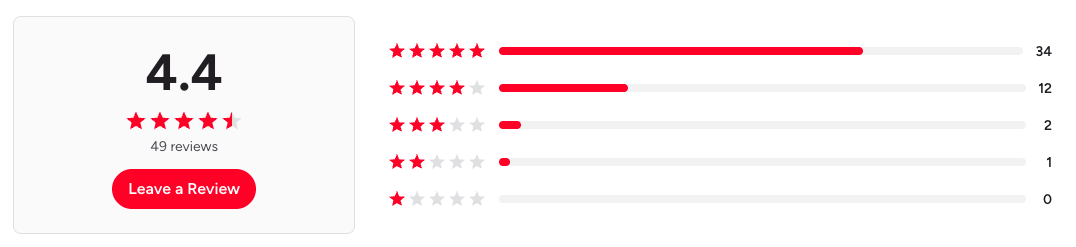
Redash – Best for SQL-First Data Teams
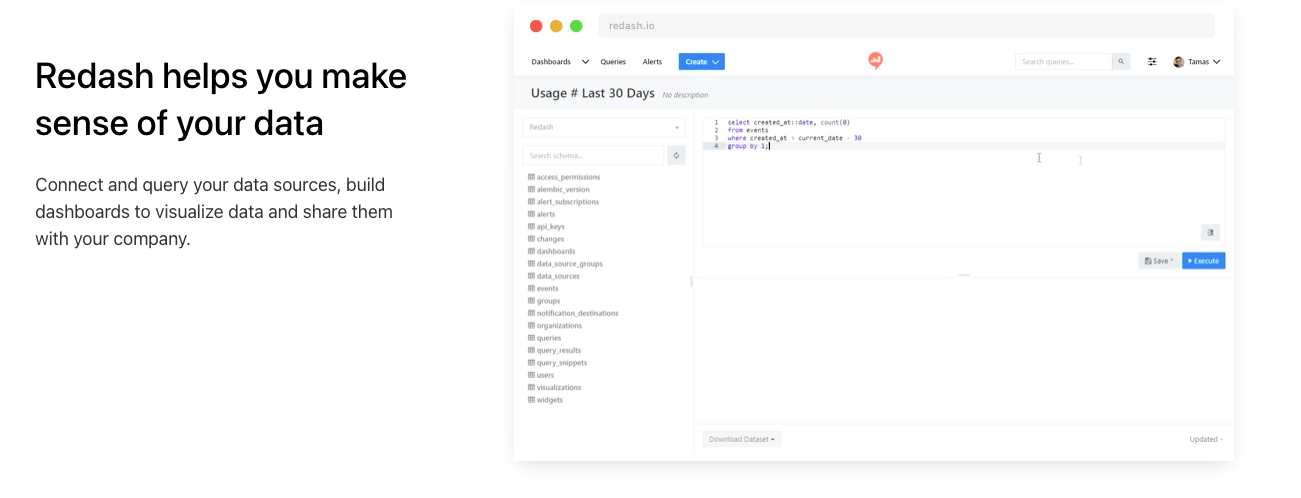
Why it stands out: Redash is beloved by data teams because it gets out of your way. No fancy no-code builder, no AI hype—just a really good SQL editor and fast dashboards.
The Redash Philosophy
Redash assumes you know SQL and just want to write queries, visualize results, and share them with your team. That's it. There's a reason it's been downloaded millions of times and has a devoted following.
Key features:
- SQL-focused: Write queries, get results, build visualizations
- Multi-database support: Connect to PostgreSQL, MySQL, BigQuery, Redshift, MongoDB, etc.
- Query scheduling: Automatically refresh dashboards on a schedule
- Simple sharing: Share dashboards via link or embed them
What You Trade Off
Redash is lightweight by design. Don't expect fancy visualizations, advanced data modeling, or AI-powered insights. It's a tool for analysts who live in SQL and want something that doesn't slow them down.
Embedding works (via iframe), but it's basic. If you need pixel-perfect white-label embedding with custom auth, look elsewhere.
Pros
✅ Extremely lightweight and fast
✅ SQL-native workflow
✅ Open-source with managed cloud option
✅ Multi-database support out of the box
Cons
❌ Limited visualization options
❌ No advanced data modeling
❌ Basic embedding capabilities
❌ Not ideal for non-technical users
Pricing
- Self-hosted: Free (open-source)
- Cloud: Starts at $49/month
Best for: Data analysts and engineers who live in SQL and want a fast, no-bullshit query tool with simple dashboards.
Tableau – Best for Enterprise Data Visualization

Why it's still relevant: Yeah, we know—Tableau feels like the old guard. But there's a reason it's still one of Gartner's Magic Quadrant leaders for analytics. When you need enterprise-grade visualizations with every chart type imaginable, Tableau delivers.
What Tableau Actually Excels At
Tableau's visualization engine is still best-in-class. The drag-and-drop interface is intuitive, and you can create complex, beautiful visualizations faster than most alternatives.
Plus, if you're already invested in the Salesforce ecosystem (they own Tableau), the integrations are solid.
Key features:
- Industry-leading visualizations: 30+ chart types with deep customization
- Desktop + Cloud: Choose between local analysis and cloud sharing
- AI-powered features: Ask Data in natural language, get automatic insights
- Enterprise security: Role-based access, data governance, audit trails
Why Teams Look for Alternatives
Price. Tableau gets expensive, especially at scale. And while they've improved the learning curve, it's still more complex than modern tools. Setting up a new data source requires more clicks than it should in 2025.
Also, embedding Tableau isn't plug-and-play. You need Tableau Server or Tableau Cloud (both $$), and the implementation requires solid technical chops.
Pros
✅ Best-in-class visualization capabilities
✅ Proven enterprise track record
✅ Strong Salesforce ecosystem integration
✅ Mature product with extensive documentation
Cons
❌ Expensive, especially for embedded use cases
❌ Steeper learning curve than modern alternatives
❌ Can feel bloated for simple use cases
❌ Embedding requires Tableau Server/Cloud
Pricing
- Tableau Creator: $70/user/month (billed annually)
- Tableau Explorer: $42/user/month
- Tableau Viewer: $15/user/month
Note: Embedding requires additional Tableau Server or Tableau Cloud licenses.
Best for: Large enterprises that need advanced visualizations, already use Salesforce, and have budget for premium tools.
Final Thoughts: Metabase Alternatives That Actually Work
Here's the truth: there's no single "best" Metabase alternative. It depends on what you're trying to do.
If you're embedding analytics in a SaaS product: Toucan and Holistics are built for this. They handle multi-tenancy, white-labeling, and user management out of the box.
If your data team lives in dbt: Lightdash is the obvious choice. Don't fight it.
If you're technical and budget-conscious: Apache Superset gives you everything, but you're managing it yourself. Preset.io if you want someone else to handle operations.
If you want something proven: Tableau isn't sexy, but it works at scale. Expensive, but you know what you're getting.
The worst decision is staying with a tool that's actively slowing you down. We've talked to too many teams who wasted months trying to make Metabase work for use cases it wasn't designed for.
Want to see how Toucan stacks up? Request a demo to see it in action or try for 14 days free.
FAQ