Vibe Coding Analytics vs. Embedded Analytics: The Real Tradeoff

Charles Miglietti
Publié le 20.05.26
8 min
|
Executive Summary AI coding tools can generate a working dashboard in two hours. But customer-facing embedded analytics for SaaS products is a different scope entirely. Multi-tenant security, a governed semantic layer, self-service governance and AI cost control are problems no prototype ever surfaces. Over three years, building this from scratch typically costs 5 to 15 times a dedicated platform license. This article breaks down where the complexity lives and how to make the right call for your team. |
|
Key Takeaways
|
The 2-hour version is real. It is also not the product.
Here is exactly what AI coding tools do well: they generate a working UI from a prompt. Simple dashboards, bar charts, SQL queries against your existing schema, basic filters. All of this is now genuinely fast to produce.
And for many teams, that is enough. If you are building an internal ops dashboard for your own team, if your use case is low-stakes and your data model is stable, vibe coding works. Ship it.
But if you are building analytics that lives inside your product, the product you sell to 50, 200, or 2,000 enterprise clients, you are not building a dashboard. You are building a product layer that has to work reliably for every tenant, every day, without a senior engineer babysitting it.
That is where the 2-hour estimate quietly becomes a 2-year problem.
|
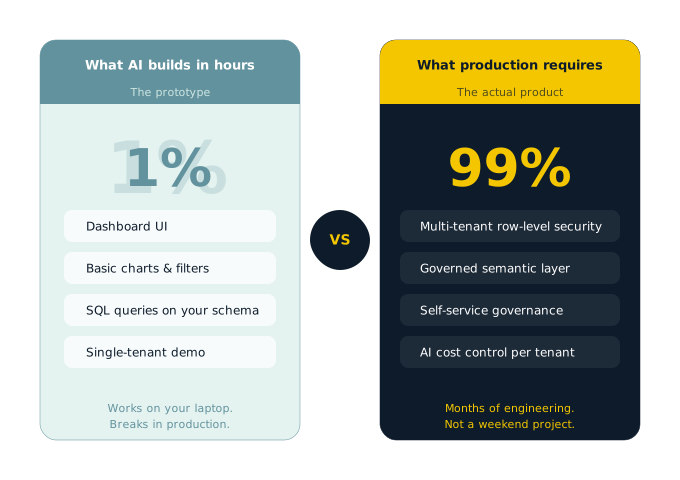
The issue is not what AI can generate. It is what production-grade customer-facing analytics actually requires. A dashboard prototype covers roughly 5% of the work. The other 95% only surfaces once your first enterprise tenant onboards and starts probing the edges of your system. |
Four problems AI will not solve for you
These are the problems that kill DIY embedded analytics projects between month 6 and month 24. They rarely show up in the prototype. They show up when your first enterprise client onboards and their security team starts asking questions.
1. Multi-tenant security is not a feature. It is an architecture.
Your application already has multi-tenancy. Your auth layer separates Client A from Client B at the application level. Most teams assume this carries over to analytics.
It does not.
Analytics requires row-level security that lives at the data layer, not just the application layer. It means that when a user of Client A runs a query, the analytics layer enforces isolation at the SQL level, not just by hiding a UI button. One misconfiguration and Client A sees Client B's revenue data.
Beyond data isolation, there is the artifact isolation question: who can see which dashboards, who can share what, who can export data, which roles get which views. This is not basic RBAC bolted onto a dashboard library. It is a dual-layer access model (ABAC plus RBAC) where data rights and artifact rights compose together, growing more complex with every new tenant and user group.
|
A single cross-tenant data leak does not just lose you a client. It loses you the trust of every client you have. This is the first question enterprise procurement teams ask before signing anything. |
2. Without a semantic layer, your metrics will lie. And your AI will make it worse.
At 10 dashboards in production, this is not a problem. At 200 dashboards in a self-service environment, it becomes a crisis.
Consider revenue. Your finance team defines it as net, after discounts and refunds, recognized by invoice date. Your sales team defines it as gross, by contract signature. Your marketing team looks at ARR and includes setup fees. None of these are wrong. They are all in active use simultaneously, and they produce different numbers for the same time period.
When an AI coding tool generates SQL for a dashboard, it generates a query against your table structure. It has no knowledge of your business definitions. At scale, in a self-service environment where your clients build their own views, you end up with 40 different definitions of the same metric coexisting in production. Finance and sales show different revenue numbers to the same customer.
This is also why connecting an LLM directly to your data warehouse via MCP is not a substitute for a governed semantic layer. The LLM will generate valid SQL. It will not generate correct answers by your business definitions unless those definitions are enforced upstream. When the CFO of one of your clients asks why the revenue figure diverges from their accounting system, "the AI calculated it differently" is not an acceptable answer in an enterprise contract.
A semantic layer forces the business to define metrics once and enforces those definitions everywhere, including in AI-generated responses. Building one from scratch is a multi-month project. Maintaining it as your data model evolves is permanent engineering overhead.
3. Self-service at scale requires governance, not just access.
The promise of self-service analytics is that your customers can explore their own data without asking your team for every answer. The reality in an enterprise environment is more nuanced: self-service does not mean every user does whatever they want. It means a structured governance layer that determines who can see what, who can share content, and what constitutes an official versus an exploratory view.
Without that layer, self-service becomes a liability. At 500 user-created dashboards, with no certification mechanism, no official content library, and no way to distinguish a tested analysis from a one-off experiment run on a Friday afternoon, the analytics environment becomes unmaintainable. Your customers lose trust in the numbers because they cannot tell which dashboards are authoritative.
What you need to build: a content hierarchy that separates certified official assets from user-generated content, admin workflows that let you promote a user analysis to an official dashboard without rebuilding it, and access controls at the artifact level. None of this is solved by a chart library or an LLM.
4. AI operating costs at scale are a pricing and margins problem.
This one almost never surfaces in the prototype phase, which is exactly why it is dangerous.
If you build your own AI-powered analytics layer and offer it to 300 enterprise tenants, you are responsible for the LLM cost generated by every query every user runs. At 10 users per tenant running 20 queries a day, the numbers grow fast. More importantly, you cannot predict them at contract signing.
Without per-tenant rate limits, usage dashboards, and cost observability at the query level, you are selling a product with an unpredictable cost structure. You will either price too high and lose deals, or price too low and watch your margins compress as usage grows. Building this instrumentation takes weeks of engineering. Maintaining it as your tenant base scales is permanent operational overhead.
What building actually costs
The prototype is not the cost. The cost is the next three years.
Getting to a production-ready embedded analytics layer for a multi-tenant SaaS product typically requires 4 to 5 engineers for 6 months in the build phase, plus at least 1 dedicated engineer in steady-state maintenance. At fully loaded costs, that is roughly $500k–600k for the initial build and $100k per year after that.
There is also the captive roadmap problem. Once your customers start using your analytics layer, they will ask for features: custom chart types, drill-downs, export formats, notification triggers. Your product team now has a second product to maintain, adjacent to your core business but not part of it.
|
Cost element |
Year 1 (build phase) |
Year 2–3 reality |
|
Initial engineering (4–5 devs × 6 months) |
~$500,000–600,000 |
Sunk cost, but tech debt accumulates |
|
Ongoing maintenance (1 FTE) |
~$100,000 |
~$100,000/year, rising with tenant count |
|
Captive feature requests from customers |
Not budgeted |
20–30% of analytics team sprints |
|
AI operating costs (LLM per query) |
Marginal at prototype scale |
Unpredictable, grows with customer usage |
|
Opportunity cost (engineers off core product) |
High |
High, permanent |
|
3-year total vs. dedicated platform |
Typically 5× to 15× a platform license. Ratio worsens with tenant count. |
|
Figures based on typical fully-loaded engineering costs for mid-size SaaS companies. Your numbers will vary depending on team seniority, feature scope, and tenant volume.
When vibe coding is the right answer
The honest version of this conversation includes acknowledging that building your own solution sometimes makes sense. Here is when it does.
Analytics is a minor, non-commercial add-on: not an argument your sales team makes, not a feature customers would churn over. Your tenant base will stay under 10, with homogeneous user profiles. Your end users are internal or highly tolerant of rough edges. You have senior engineers available who actively want to own the stack.
If all four of those are true, building is a reasonable choice. Start with vibe coding, ship something that works, and revisit the decision when analytics starts appearing in your customer conversations.
The mistake is not deciding to build when conditions favor it. The mistake is deciding to build without understanding the full scope of what you are committing to.
Build vs. buy: the actual decision framework
The question is not "can we build a dashboard with AI?" The answer to that has been yes for over a year. The real question is whether you are willing to commit 5 engineers, 6 months, and 30% of your roadmap to building an analytics product that is not your core business, and then maintain it indefinitely while your customers ask for more features.
|
Signal |
Building |
Buying |
|
Analytics in your product pitch |
Nice-to-have, rarely mentioned |
Core feature, customer expectation |
|
Number of customer tenants |
Under 10, similar profiles |
20+, diverse security requirements |
|
End users |
Internal or tolerant of rough edges |
Enterprise clients with SLAs |
|
Engineering team focus |
Senior devs who want ownership |
Team must stay on core product |
|
Time-to-market pressure |
Low, no competitive analytics pressure |
Competitors already shipping analytics |
|
White-label requirement |
None required |
Full brand control required from day one |
|
Multi-tenant RLS requirement |
Not required or manageable manually |
Required, must be automatic at scale |
What an embedded AI analytics platform handles for you
Toucan is an embedded AI analytics platform built specifically for ISVs and SaaS product teams. The architecture was designed for one thing: letting you ship customer-facing analytics fast, without taking on the infrastructure problems described above.
Multi-tenant isolation is handled at the token level, not just the application layer. Row-level security is built in. Dashboard versioning, data model migration handling, and fine-grained editing post-AI generation are all part of the platform.
The conversational AI layer sits on top of a governed semantic layer. The answers your customers get are anchored to certified metric definitions. The AI does not generate arbitrary SQL against your raw warehouse. It answers within a defined perimeter, with explainability built into every response.
ISV teams using Toucan typically ship their first embedded dashboard in days, not quarters, without adding headcount. Engineering keeps its sprints on the core product. Analytics becomes a retention and upsell lever, not a maintenance burden.
FAQ
Can you really build customer-facing embedded analytics with AI coding tools?
Yes, with significant caveats. AI tools like Cursor and Lovable can generate a working dashboard UI in hours. What they cannot do is handle multi-tenant data isolation, row-level security, a certified semantic layer, AI cost governance, or self-service access controls. Those are product-level problems that require intentional architecture, and they are the parts that matter most when your analytics runs in a customer-facing environment at scale.
What is the real cost of building embedded analytics in-house?
The build phase for a production-ready embedded analytics layer typically requires 4 to 5 engineers for 6 months, plus at least 1 engineer in maintenance. At fully loaded engineering costs, that is roughly $500k–600k to build and $100k per year to run. Over 3 years, building from scratch typically costs 5 to 15 times a dedicated platform license, a ratio that gets worse as your tenant count and feature requirements grow.
What is multi-tenant row-level security and why does it matter?
Multi-tenant row-level security (RLS) ensures that when Customer A queries your analytics layer, they can only access their own data, enforced at the SQL level, not just at the UI level. For SaaS products with multiple clients sharing the same infrastructure, RLS is non-negotiable. A misconfigured analytics layer can expose one client's data to another, leading to contract breaches, loss of trust, and regulatory exposure. Building robust RLS from scratch requires intentional data architecture and ongoing maintenance as your data model evolves.
Why do AI-generated analytics answers sometimes give wrong numbers?
When you connect an LLM directly to a data warehouse, it generates SQL based on table names and schema structure. It has no knowledge of your business definitions: whether revenue means gross or net, or whether an active user is defined by login or by a meaningful action. Without a semantic layer anchoring the AI to certified metric definitions, the same question can produce different answers depending on how it is phrased. Trustworthy AI analytics requires a governed semantic layer, not just a system prompt.
When does it make sense to build embedded analytics yourself?
Building your own embedded analytics makes sense when: analytics is a minor internal feature rather than a commercial argument, your tenant base is small (under 10) with homogeneous user profiles, your end users are internal or highly tolerant of rough edges, and you have senior engineers who want ownership of the stack. If all four are true, building is a reasonable choice. If analytics is customer-facing, revenue-affecting, or part of your product's competitive differentiation, a dedicated platform will almost always produce better outcomes at lower total cost of ownership.
What are the alternatives to building analytics with vibe coding tools?
ISVs evaluating purpose-built platforms most commonly consider Toucan, Luzmo, Explo, and GoodData. These platforms are designed specifically for embedded use cases, include native multi-tenancy and white-labeling, and integrate significantly faster than a custom build. The key difference is that you are paying for a maintained product rather than building and maintaining one yourself, which keeps your engineering team focused on your core product differentiation.
Related articles