The AI-Augmented Product Manager: 5 Ways the PM Role Is Expanding in 2026

Adrien Deyhim
Publié le 21.04.26
8 min
Your backlog is full. Your engineers are busy. Your research team does not exist. And your customers want more, faster.
If that sounds familiar, you are not alone. Most product teams at SaaS companies and ISVs are running lean, making decisions with incomplete data, and shipping slower than they should.
AI is not solving all of that. But it is quietly changing what a single PM can own, decide, and ship without depending on others.
This article is based on a live conversation between Adrien Deyhim, CPO at Toucan, and Anand Inamdar, CEO at Olvy, two operators who have spent the past year figuring out what actually changes when you hand a PM the right AI tools. Not the theory. The practice.
Here is what they found.
1. Feedback Analysis at Scale
Three years ago, a typical discovery cycle looked like this: gather feedback from Mixpanel, a product Slack channel, support tickets, and a Google Sheet. Hand it to a UX researcher or data analyst. Wait. Get a summary. Start over.
The bottleneck was not effort. It was capacity. Most product teams at lean ISVs do not have a dedicated product data analyst. At Toucan, there was none. At Olvy, the same.
AI changed that arithmetic.
"We were always thinking: if we had those people, we could do so much more," Adrien explains.
"Now we can manage more with less. For small-scale companies, that's genuinely good news."
The shift happened in two stages. First, LLMs became capable enough to ingest feedback from multiple unstructured sources, whether that is video transcripts, support tickets, app store reviews, or Slack channels, and return clustered themes in minutes. Second, the ability to drill back down from a summary to the original raw data became reliable enough to close the loop.
At Toucan, the team built an N8N workflow that pulls from their product feedback channels and delivers a monthly Slack digest, automatically tagged by product area, with no manual work after the initial build. Not elegant. But functional.
Anand's take is practical: "If your team is small and doing five to ten customer conversations a month, you do not need a paid tool. NotebookLM or a comparable free tool can give you insights almost instantly."
The nuance worth noting: this only works cleanly at low volume. As data sources multiply and conversation counts grow, the context window becomes a real constraint. That is the gap Olvy is building into.
For ISVs thinking about their own product analytics layer, the implication is direct. The teams that will outcompete you are not building bigger research departments. They are building better pipelines.
What Toucan does here: Toucan AI lets ISVs embed a conversational analytics layer directly in their product, so end users can ask questions in natural language and get instant answers without training, SQL, or a BI team in the loop.

2. From Idea to Prototype
Here is a scenario most PMs will recognize. You have an idea. You schedule a meeting to share it. You spend forty minutes explaining it with words while stakeholders nod politely and leave with a different mental model than the one you had.
The problem is not the idea. It is the medium.
"One image is worth a thousand words," Adrien says.
And for the first time in the history of the PM role, generating that image takes less time than writing the PRD that would describe it.
Tools like Lovable, v0, and Bolt have made throwaway prototypes shockingly good. Feed in a rough description, get a working-looking interface back in minutes. The prototype is not the product. But it surfaces questions immediately, before anyone has committed to anything.
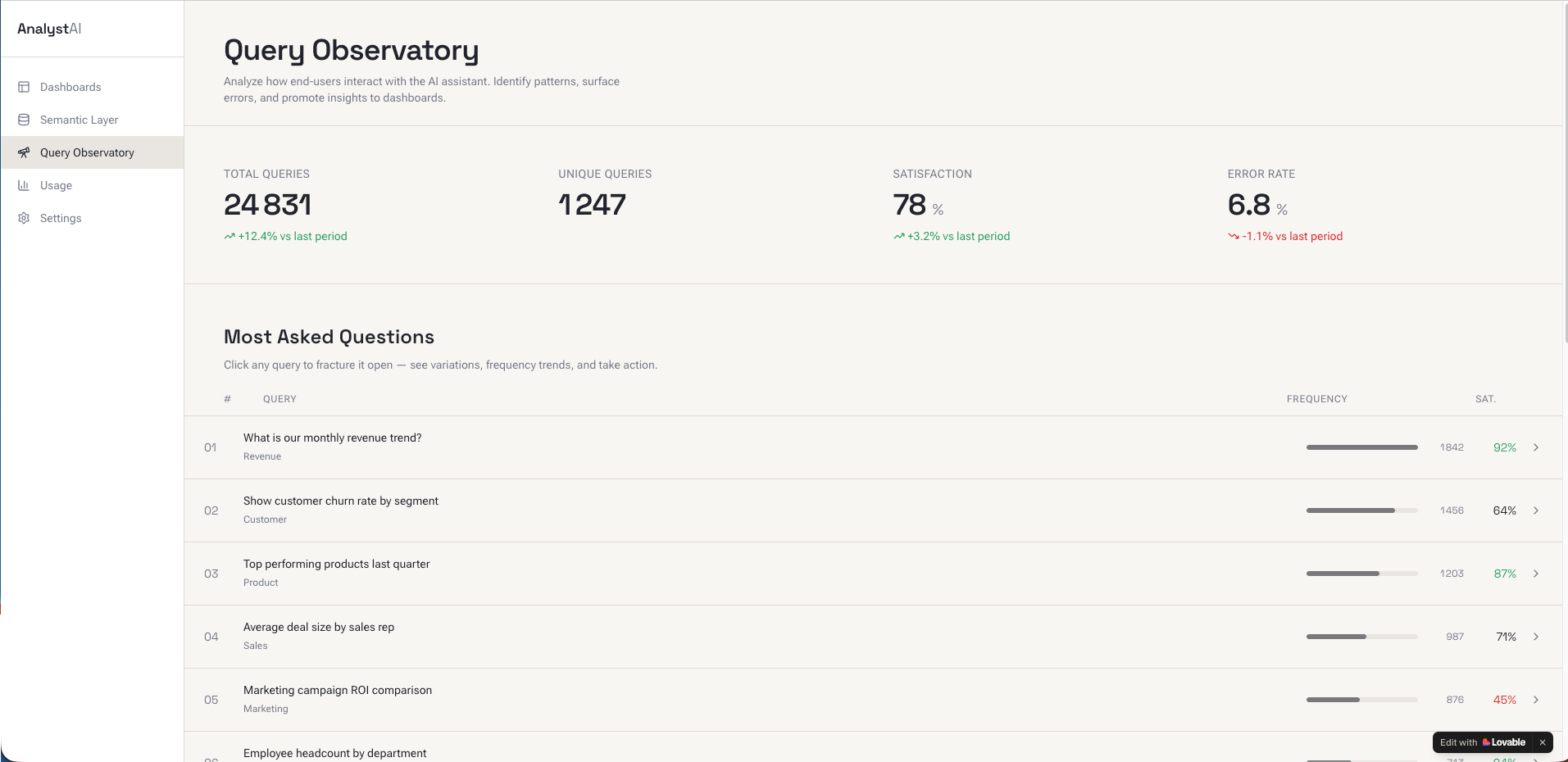
At Toucan, the team built a quick prototype of a "Query Observatory," a dashboard that would show product teams which questions their users were asking, and what the error and satisfaction rates looked like. They used it as a conversation starter. Two weeks later, they built the real version during a hackathon.
The key insight: prototyping is useful for the questions it raises, not the answers it provides.
Anand holds the contrarian view. And it is worth hearing. "When you used to write that PRD yourself, you were thinking through the repercussions in your mind. If you outsource that to a prototyping tool without bringing your own thinking, you might propose something that already exists or that has no original value."
The conclusion they landed on: use AI prototyping early to kick off a conversation. Then override it with your own judgment. The tool is a sparring partner, not a replacement for product thinking.
For ISVs building analytics experiences into their products, this matters. A quick Toucan prototype can help your product team align with engineering on what the analytics layer should look like before a single sprint is planned.
3. Writing Specs Engineers Actually Follow
Confluence pages that nobody reads. Jira tickets that miss the point. Acceptance criteria that are technically correct and practically useless.
If you have shipped a feature that did not match what you specified, you already understand the problem.
Adrien started experimenting with specification-driven development using Spec-it, an open-source library from GitHub, integrated into Cursor. The workflow goes like this: the PM writes a pitch or a rough idea. Spec-it generates structured specifications in standard format, user stories, expected behaviors, acceptance criteria, the whole thing, in a fraction of the time it used to take.
Then comes the more interesting step: implementation planning. Spec-it translates those specs into a plan that lives inside the codebase, bridging product thinking and engineering thinking in a shared document.
"Getting inside the codebase was something we could do before," Adrien says. "But AI gave us a good reason to actually go there."
The shift is significant. Product and engineering now work in the same source of truth. Not two separate tools with a hand-off in between.
One practical guard against AI-generated noise: Toucan built what they call a "constitution" markdown file. It sits inside the codebase and gives the LLM a set of rules before it generates anything. Core concepts. Glossary. Non-negotiable behaviors. Their CTO made this a condition of letting PMs touch the codebase.
If you are running AI-generated specs without something like this, you will eventually ship something that looks right and behaves wrong.
4. The Fixes That Are Not Worth a Ticket
There is a class of product debt that almost every team quietly ignores. Typos. Missing analytics trackers. Small UI inconsistencies. A confirmation message that is slightly confusing but not broken enough to prioritize.
These tasks share one thing: by the time a developer gets to them, the context has changed. The product has moved on. The question that motivated the fix is no longer relevant.
Adrien's framing: "We were taking more time writing the ticket and explaining it to a developer than just doing it ourselves."
So they started doing it themselves.
Not to replace engineering. Not to add velocity. To improve quality on the things that otherwise never get done. The distinction matters. This is not vibe coding as a development strategy. It is vibe coding as a quality maintenance tool.
Anand connects this to his own experience. When ChatGPT launched, he started using it to write SQL queries he no longer had the fluency for. No ticket to the engineering team. No two-week wait. Just: here is what I am trying to understand, here is the table structure, give me the query.
The output: faster answers, better product decisions, and no lost sprint cycles on a question that would be obsolete by the time it was answered.
To manage the risk of PMs shipping things they should not, Toucan built a "Feature Complexity Assessor" skill in Cursor. Before a PM commits any code, they trigger the assessor. It evaluates the change and classifies it as either low-risk (safe to push to production, pending a quick engineering review) or POC (proof of concept only, hand off to the engineering team). Engineers retain merge rights. Always.
"Simple stuff is now something we can do," Adrien says. "But when it involves backend development, we are not there yet."
That is the right calibration.
5. Knowing When to Push Back on the AI
This is the part that does not make it into most AI-and-PM articles. Because it is inconvenient.
The same tools that expand what a PM can do also create pressure to do more of it. Faster prototypes mean more prototypes. Better specs mean more features. A feedback tool that processes 500 inputs in ten minutes means you feel like you should process 5,000.
But the PM role was already at risk of becoming a feature factory before AI. Now the cost of development is lower, the volume of output is higher, and the judgment required is exactly the same as it was before.
Adrien's take: "Product management is becoming the new bottleneck. Not engineering. We have to think faster and think better, because the teams shipping code are not waiting anymore."
The trap Anand identifies: using AI to generate more without using it to think harder. His counter-practice is deliberate. When an AI tool recommends a direction, he asks it to debate that recommendation from the opposite angle. What if this suggestion is completely inaccurate? Build the case against it.
"I use these tools every day," he says. "But when I'm about to make a decision, I go reverse on it."
The best AI use case for a PM is not generation. It is challenge. Use it to expose your blind spots before they become shipped features.
The question worth asking before you push anything to engineering: would I be comfortable sharing this reasoning with the team? If the answer is no, the AI did the thinking and you approved it.
That is not product management.
The Surface Area Is Bigger. The Judgment Required Is Not Smaller.
Here is the summary that Adrien and Anand kept circling back to, in different ways, across a fifty-minute conversation.
AI expands the PM's surface area. Discovery, prototyping, specs, micro-fixes, data analysis: a single PM can now do more of these without handing off. That is real and it matters.
But the surface area is not the job. The job is making the right calls on what to build, for whom, and in what order. AI does not do that. It accelerates the inputs. The decision is still yours.
The PMs who will win in 2026 are not the ones who use the most tools. They are the ones who use the tools to think better, challenge their assumptions earlier, and ship fewer things that actually matter to customers.
Do less. Do it better. Move faster on the things that count.
How Toucan Fits Into This Picture
When your product team is making faster decisions with better data, the next question is: are your customers getting the same experience inside your product?
Toucan is an embedded analytics platform built for ISVs and SaaS companies. It lets you give your customers a conversational, AI-native analytics experience directly inside your product, without building a BI layer from scratch or diverting engineering sprints from your core roadmap.
The teams using Toucan typically ship their first embedded dashboard in days. Without adding headcount. Without asking engineers to maintain a custom multi-tenant analytics stack.
If your product roadmap includes any kind of in-app reporting or analytics, that is the conversation worth having.
See how ISVs embed analytics without the engineering overhead. Strat your free trial.
FAQ
Does AI replace the product manager role?
No. AI expands what a product manager can do independently, including feedback analysis, prototyping, and spec writing, but it does not replace the judgment required to decide what to build. The PM role is changing faster than it is shrinking. The risk is not automation: it is using AI output without applying your own thinking first.
What is an AI-augmented product manager?
An AI-augmented product manager is a PM who uses AI tools to independently cover work that previously required dedicated researchers, analysts, or developer hand-offs. This includes synthesizing user feedback at scale, generating functional prototypes before stakeholder meetings, and making minor product fixes without opening a ticket. The key distinction is that the PM still makes the decisions. AI accelerates the inputs.
How are PMs using AI for product discovery in 2026?
The most common pattern is using LLMs to process feedback from multiple unstructured sources (support tickets, interview transcripts, Slack channels, app store reviews) and return clustered themes. Tools like Olvy automate this at the product level. Smaller teams use free tools like NotebookLM for lower volumes. The output is a faster, more systematic picture of customer pain, without a dedicated research team.
Should product managers learn to code in 2026?
Not necessarily. What is changing is that PMs can now make small, low-risk contributions to the codebase, such as fixing typos, adding analytics events, or adjusting UI copy, without deep engineering knowledge. Tools like Cursor and AI coding assistants make this accessible. The limit is clear: backend complexity, security, and architecture remain engineering territory. The goal is quality improvement, not velocity.
What is the biggest risk of AI tools for product managers?
Volume without judgment. AI makes it easy to generate more: more prototypes, more features, more specs. The feature factory risk that product teams have talked about for years is now amplified because the cost of development has dropped. The PMs who avoid this trap use AI to challenge their thinking, not just accelerate it.
This article is based on a live webinar hosted by Toucan and Olvy on April 16, 2026. Speakers: Adrien Deyhim, CPO at Toucan, and Anand Inamdar, CEO at Olvy.
[Watch the full replay here: https://youtu.be/BvC37lOjXas]