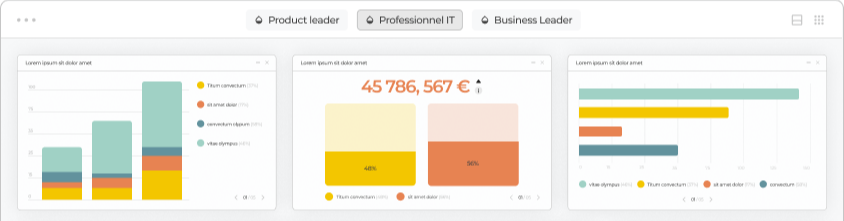
Embedded Reporting - Turn Your Users into Report Creators

Alim Goulamhoussen
Publié le 10.03.26
6 min
Résumer cet article avec :
What is Embedded Reporting?
Embedded reporting is the integration of reporting and analytics capabilities directly into an existing software application. Rather than pointing users to a standalone BI tool, you surface reports, dashboards, and data exports natively inside your product UI — fully branded, contextually relevant, and accessible without a separate login.
The result: your users get insights where decisions happen — inside your product — not in a third-party tool they may never adopt.
Embedded reporting is a core component of embedded analytics — the broader practice of building analytics features into software products for end users.
Embedded Reporting vs Related Concepts
Before going deeper, it helps to clarify how embedded reporting relates to adjacent terms you'll encounter when evaluating solutions.
|
Term |
Definition |
Key distinction |
|---|---|---|
|
Embedded reporting |
Reports and dashboards integrated inside your product UI |
Native UX, no context switch |
|
Embedded analytics |
Broader category: reporting + ad-hoc analysis + AI queries + exploration |
Embedded reporting is a subset |
|
White label reporting |
Embedded reporting fully branded as your product (logo, colors, no vendor branding) |
Branding emphasis |
|
Self-service reporting |
Users can build their own reports within guardrails, not just consume pre-built ones |
User agency dimension |
|
External BI tools |
Standalone tools like Tableau, Power BI used separately from the product |
Requires context switch, separate login |
Why SaaS Products Need Embedded Reporting
The shift toward embedded reporting isn't aesthetic — it's driven by measurable business outcomes.
Reduce churn through data engagement
Products that surface relevant data to users see significantly higher engagement and retention. When your customers can see the ROI of your product inside your product, they renew. When they have to export CSVs to Excel to understand what's happening, they churn.
Reduce support and custom reporting requests
Every 'can you send me a report on X?' request your CSM team handles is a signal that your product isn't delivering enough data transparency. Embedded reporting systematically eliminates these requests by giving users self-service access.
Create a premium upsell tier
Advanced reporting, custom dashboards, and scheduled exports are consistently among the highest-converting premium features for SaaS products. Embedded reporting gives you a natural analytics tier to monetize.
Compete at the product level
In most SaaS verticals, embedded analytics and reporting have moved from differentiator to expectation. If your competitors offer it and you don't, it becomes a reason to churn — not just a nice-to-have.
How Embedded Reporting Works: Technical Architecture
Understanding the technical layers helps you evaluate build vs buy, assess integration complexity, and design the right experience.
Layer 1 — Data connectivity
Embedded reporting connects to your data sources — typically your application database (PostgreSQL, MySQL), a data warehouse (Snowflake, BigQuery, Redshift), or a REST API. Query performance at this layer determines report load times.
Layer 2 — Semantic layer and metric definitions
A well-architected embedded reporting solution includes a semantic layer: a governed, human-readable definition of your metrics, KPIs, and dimensions. This ensures consistency — 'revenue' means the same thing everywhere in your product.
Layer 3 — Report and dashboard builder
This is the configuration layer where your team (or, with self-service, your users) builds reports: choosing metrics, defining filters, selecting chart types, setting up scheduled exports.
Layer 4 — Multi-tenant delivery and security
This is the most critical layer for SaaS products. Your embedded reporting must deliver the right data to the right user — which means row-level security (each tenant sees only their data), role-based access control, and SSO/JWT authentication that connects to your existing auth.
Layer 5 — White-label rendering
The final layer is presentation: your logo, your color palette, your typography. A fully white-labeled embedded reporting solution is indistinguishable from a natively built feature.
Key Features to Look for in an Embedded Reporting Platform
|
Feature |
Why it matters |
What to check |
|---|---|---|
|
Multi-tenancy |
Each customer sees only their data |
Row-level security, JWT/SSO, tenant isolation |
|
White-label |
Reports feel native to your product |
Custom logo/colors, removable vendor branding |
|
Self-service builder |
Users create their own reports |
Guardrails, permission levels, template control |
|
No-code configuration |
Product teams maintain without dev resources |
Visual builder, no SQL required |
|
Scheduled exports |
PDF/CSV delivery on schedule |
Email delivery, format options, frequency control |
|
AI-powered queries |
Users ask questions in plain language |
Natural language → chart, no SQL |
|
SDK / embed API |
Integrate into your UI cleanly |
iFrame, JS SDK, React component |
|
Performance at scale |
Fast load times as user base grows |
Caching, warehouse pushdown, CDN |
|
Governance and audit |
Enterprise compliance |
Access logs, permission hierarchy, SSO |
Embedded Reporting and AI: The Next Level
The most advanced embedded reporting platforms in 2026 are moving beyond static pre-built reports toward conversational, AI-powered reporting.
With Toucan.ai, for example, users can type a question — 'What were our top 5 accounts by revenue last quarter?' — and get an instant chart or KPI card, without writing SQL or navigating report menus. The AI interprets the question against a governed semantic layer, generates the query, and returns a visual result.
This isn't a gimmick. For non-technical end users — a store manager, a franchise owner, a healthcare administrator — the ability to ask questions in plain language dramatically increases data engagement and reduces support burden.
This approach is increasingly positioned under the label of AI conversational analytics — a separate but related capability worth evaluating alongside traditional embedded reporting.
Embedded Reporting for SaaS: Specific Considerations
If you're a SaaS product team evaluating embedded reporting, these dimensions matter more than generic feature lists.
Time to value
How long before your first report is live for customers? Some platforms require months of implementation. Modern embedded reporting platforms should deliver a working prototype in days and a production-ready integration in 2–6 weeks.
Engineering ownership vs product ownership
If maintaining your embedded reporting requires dedicated engineering time — every time you need to modify a report, add a metric, or onboard a new customer — you've built technical debt, not a product feature. Look for platforms with a no-code builder that lets product managers and customer success teams own the analytics layer.
Scalability from 10 to 10,000 tenants
Your embedded reporting architecture needs to work as you scale. Multi-tenant architecture, efficient query routing, and caching strategies determine whether your reporting feature degrades as your customer base grows.
Compliance and data residency
For SaaS products in regulated industries (fintech, healthcare, HR tech), embedded reporting must meet compliance requirements: SOC 2, GDPR, HIPAA considerations. Self-hosted deployment options matter here.
Build vs Buy: Embedded Reporting
Almost every SaaS team at some point considers building their own reporting layer. Here's an honest comparison.
|
Dimension |
Build in-house |
Buy embedded reporting platform |
|---|---|---|
|
Time to first report |
3–6 months minimum |
Days to weeks |
|
Engineering cost |
High (ongoing) |
Low (configuration) |
|
Feature breadth |
Limited to what you scope |
Full platform (charts, exports, AI, etc.) |
|
Multi-tenancy |
Custom-built security risk |
Built-in, tested at scale |
|
White-labeling |
Full control |
Full control (with right platform) |
|
Maintenance |
Your team forever |
Vendor handles product evolution |
|
AI capabilities |
Requires ML/AI team |
Out of the box |
For a detailed analysis, see our guide: Embedded Analytics Build vs Buy →
Top Embedded Reporting Platforms in 2026
Here's a brief overview of leading embedded reporting platforms to help you orient your evaluation.
Toucan
Purpose-built for SaaS and ISV embedded reporting. Fully white-labeled, no-code builder for product teams, native multi-tenancy, and Toucan.ai for natural language queries. Fastest time to production in the category. Strong G2 ratings for ease of use and implementation.
Luzmo
Strong embedded dashboard platform with good self-service editor for end users. Good fit for teams who want customers to build their own reports. Less emphasis on curated, product-owned experiences.
GoodData
Enterprise-grade embedded analytics and reporting. Rich feature set but heavier implementation. Better suited for large organizations with dedicated data teams.
Sisense
Full-stack embedded BI with deep customization. More developer-centric, higher implementation complexity. Appropriate for enterprise teams with engineering resources.
Power BI Embedded
Microsoft-native embedded reporting. Strong if your stack is Azure/Microsoft. Less suited for non-Microsoft SaaS products due to ecosystem coupling and higher TCO.
For a full comparison, see: Best White Label Reporting Tools 2026 →
Implementation: Getting Started with Embedded Reporting
A typical embedded reporting implementation with a modern platform follows these phases:
- Data audit (week 1): Identify your data sources, key metrics, and how data is structured for each tenant.
- Platform setup and connection (week 1–2): Connect your database or warehouse to the embedded reporting platform. Validate queries and data integrity.
- Semantic layer and metric definition (week 2–3): Define your metrics, KPIs, and dimensions in the platform's semantic layer. This governs what users can query.
- Report and dashboard build (week 3–4): Configure your reports and dashboards using the no-code builder. Apply white-label theming.
- Multi-tenant security testing (week 4–5): Test row-level security and tenant isolation. Validate that each user sees only their data.
- SDK integration and UAT (week 5–6): Integrate the embed SDK into your product UI. Run user acceptance testing with a pilot customer cohort.
- Production rollout (week 6+): Gradual rollout to full customer base. Monitor performance, engagement, and support ticket volume.
Frequently Asked Questions
What is the difference between embedded reporting and a BI tool?
A BI tool is a standalone application (like Tableau or Power BI) that users access separately. Embedded reporting is integrated directly into your product UI — users never leave your application to access their reports.
Does embedded reporting require SQL knowledge?
With modern embedded reporting platforms like Toucan, no. Product teams configure reports through a visual, no-code builder. End users consume reports — and with AI-powered platforms, can ask questions in plain language — without writing SQL.
How does row-level security work in embedded reporting?
Row-level security (RLS) restricts the data returned by a query based on the authenticated user's attributes — typically their tenant ID, role, or permissions. The embedded reporting platform enforces these rules at query time, ensuring tenants never see each other's data.
Can embedded reporting be white-labeled?
Yes. Most embedded reporting platforms offer white-label options: custom logo, brand colors, typography, and the ability to remove vendor branding. The level of white-labeling varies by platform — evaluate this carefully if brand consistency matters for your product.
How long does it take to implement embedded reporting?
With a modern platform like Toucan, a working prototype typically takes days, and a production-ready integration takes 2–6 weeks. Legacy BI tools can require 3–6 months.
What data sources does embedded reporting support?
Modern embedded reporting platforms support most common sources: PostgreSQL, MySQL, Snowflake, BigQuery, Redshift, and REST APIs. Evaluate specific connector support for your stack before committing.
Related Resources
→ What is Embedded Analytics? Complete Guide
→ White Label Reporting: Complete Guide
→ Embedded Analytics vs Traditional BI
→ Embedded Analytics Build vs Buy
→ Best White Label Reporting Tools 2026

Alim Goulamhoussen
Alim is Head of Marketing at Toucan and a growth marketing expert with over 8 years of experience in the SaaS industry. Specialized in digital acquisition, conversion optimization, and scalable growth strategies, he helps businesses accelerate by combining data, content, and automation. On Toucan’s blog, Alim shares practical tips and proven strategies to help product, marketing, and sales teams turn data into actionable insights with embedded analytics. His goal: make data simple, accessible, and impactful to drive business performance.
Voir tous les articles