Embedded Analytics vs Traditional BI: Complete Comparison (2026)

Alim Goulamhoussen
Publié le 10.03.26
8 min
Résumer cet article avec :
What Is Traditional BI? Definition and Core Architecture
Traditional Business Intelligence (BI) refers to the set of tools, processes, and systems that organizations use to collect, analyze, and report on data — primarily for internal decision-making. The category includes tools like Tableau, Power BI, Looker, Qlik, and MicroStrategy.
The architecture of traditional BI follows a consistent pattern:
- Data is extracted from source systems and loaded into a central data warehouse
- BI analysts or data engineers build data models, calculated fields, and semantic layers
- Reports and dashboards are created by trained BI users in the BI tool
- Business stakeholders access pre-built views through the BI platform
- New questions require new dashboard requests, backlogs, and development cycles
Traditional BI was designed for a world where data was scarce and access was centralized. The analyst team controlled the data, built the views, and distributed insights to the rest of the organization. For internal analytics at scale, this model worked reasonably well.
Who traditional BI was built for
Traditional BI tools were designed with data analysts and BI developers as the primary users — people who understand SQL, data modeling, and complex visualization configuration. Business users are consumers of the output, not creators of it.
This distinction is important: the entire architecture assumes a separation between those who build analytics and those who consume it. Embedded analytics challenges that assumption entirely.
What Is Embedded Analytics? Definition and How It Works
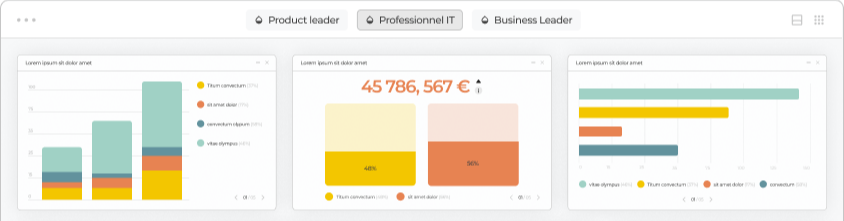
Embedded analytics is the integration of analytical capabilities — dashboards, reports, charts, KPIs — directly inside another application, rather than in a standalone BI tool. The analytics experience is part of the product, not a separate destination.
For SaaS companies and ISVs, this typically means:
- A reporting tab or analytics section inside your product
- Dashboards that appear in context — next to the data they describe
- Client-facing reports accessible to your customers without leaving your platform
- Multi-tenant data isolation so each client sees only their own data
- White-label branding so the analytics experience matches your product identity
→ Read more: What Is Embedded Analytics? Definition, Examples and Benefits
How embedded analytics works technically
A modern embedded analytics platform connects to your data sources (databases, warehouses, APIs), applies a semantic layer to define metrics and access rules, and renders visualizations inside your product via iframe, SDK, or API. Authentication flows through your existing SSO, so users never need a separate login.
The key technical difference from traditional BI: the analytics module is deployed as a component inside your product's UI, not as an external tool users navigate to separately.
Key Differences: Embedded Analytics vs Traditional BI
The differences between embedded analytics and traditional BI go beyond deployment model. They reflect fundamentally different design philosophies about who analytics is for and how it should be delivered.
|
Dimension |
Traditional BI |
Embedded Analytics |
|
Primary audience |
Internal analysts & BI teams |
End users & customers (non-technical) |
|
Deployment |
Standalone tool — separate from product |
Integrated inside the product/application |
|
Access model |
Users log into the BI tool |
Users access analytics within your app (SSO) |
|
Who builds dashboards |
BI developers / data analysts |
Product/ops teams, often no-code |
|
Data audience |
Internal org only |
External clients, partners, or internal users |
|
Multi-tenancy |
Not native — complex workarounds needed |
Native — each client sees only their data |
|
Branding |
Vendor-branded interface |
White-label — your logo, colors, domain |
|
Time to new report |
Days to weeks (backlog + dev cycle) |
Hours (no-code builder) |
|
User adoption |
30–40% typical for non-technical users |
60–70%+ with in-product analytics |
|
Setup time |
Months for enterprise deployment |
Weeks with purpose-built platform |
|
Pricing model |
Per-seat or enterprise license |
Per end-user or usage-based |
|
Best for |
Internal, analyst-led data exploration |
Customer-facing, product-embedded analytics |
Where Traditional BI Falls Short
Traditional BI tools were built for a specific context: internal analytics teams in large enterprises with dedicated data infrastructure. For that context, they remain powerful. But for SaaS companies building customer-facing analytics, traditional BI creates structural problems.
Problem 1: It wasn't designed for external users
Traditional BI tools assume a single organization with a single identity model. Multi-tenant architectures — where each customer of your SaaS product needs to see only their own data — require complex workarounds: separate database schemas per client, manual row-level security configuration, or multiple separate BI instances. None of these scale economically.
Problem 2: The analyst bottleneck
Every new dashboard, new KPI, or new report requires going through a BI developer or data analyst. For product teams trying to iterate quickly on analytics features, this creates a permanent backlog. By the time the report is built, the business question has changed.
Problem 3: Low adoption outside the data team
Traditional BI tools are built for people who think in data structures. Store managers, account executives, HR coordinators — the people who actually make operational decisions — find them intimidating or confusing. Adoption rates outside the core data team consistently run 30-40%. The majority of dashboards built are rarely opened.
Problem 4: No white-label capability for client-facing use
If you're a SaaS company delivering analytics to your customers, you cannot put a Tableau or Power BI logo inside your product. Traditional BI tools offer limited or no genuine white-label capability. Your clients see your competitors' branding — not yours.
Problem 5: Vendor lock-in and TCO
Enterprise BI licenses are expensive, complex, and designed to expand. As usage grows, pricing escalates significantly. For ISVs who need to support thousands of end-user tenants, per-seat BI pricing becomes prohibitive. And migration away from an established BI tool involves re-building years of data models.
Where Embedded Analytics Wins
Embedded analytics was designed specifically to solve the problems that make traditional BI a poor fit for product-led SaaS companies. Here is where the advantage is most concrete.
Higher user adoption — because analytics is where users already are
When analytics is embedded in your product — visible in context, accessible without a separate login, styled to match your UI — users engage with it naturally. There is no friction of 'going to the analytics tool.' The data is simply part of the experience. In-product analytics consistently drives 2-3x higher adoption rates compared to stand-alone BI tools.
Native multi-tenancy — built for client-facing use
Embedded analytics platforms designed for SaaS handle multi-tenancy natively. Row-level security rules, tenant isolation, and permission models are core features — not afterthoughts. Each client automatically sees only their own data, with no engineering workaround required.
No-code builder — product teams own analytics
With a no-code embedded analytics builder, your product managers, customer success team, or operations staff can create and update dashboards without writing SQL or waiting for an engineering sprint. This eliminates the analyst bottleneck and dramatically shortens iteration cycles.
Time-to-market measured in weeks, not months
Purpose-built embedded analytics platforms are designed for fast deployment. Most ISVs go from zero to a first client-facing dashboard in 2-4 weeks. Building equivalent functionality in-house typically takes 6-18 months, and maintaining it requires ongoing engineering capacity.
White-label — analytics as part of your brand
Embedded analytics platforms offer genuine white-label capability: your logo, your colors, your domain, your SSO. Clients experience analytics as a native feature of your product — not a third-party tool bolted on. This strengthens brand perception and increases the perceived value of your product.
→ See also: Benefits of Embedded Analytics and Challenges
Head-to-Head: Embedded Analytics vs Traditional BI by Use Case
The right choice depends on your specific situation. Here is how the two approaches compare across the scenarios product teams actually face.
|
Use case |
Traditional BI |
Embedded Analytics |
|
Dashboards for your customers |
❌ Not designed for external users |
✅ Core use case |
|
White-label client reporting |
❌ Vendor branding visible |
✅ Full white-label |
|
Multi-tenant SaaS (100s of clients) |
❌ Complex, expensive workarounds |
✅ Native multi-tenancy |
|
Non-technical users need data |
⚠️ Steep learning curve |
✅ Designed for non-technical users |
|
Product team owns analytics |
❌ Requires BI developer |
✅ No-code builder |
|
Fast iteration on reports |
❌ Backlog-driven, weeks per change |
✅ Hours with no-code builder |
|
SSO with your existing auth |
⚠️ Complex — depends on tool |
✅ Native SSO integration |
|
Deep internal data exploration |
✅ Full ad-hoc capability for analysts |
⚠️ Curated experience, less open-ended |
|
Complex custom SQL models |
✅ Full SQL access |
⚠️ Depends on platform |
|
Enterprise internal reporting |
✅ Purpose-built for this |
⚠️ Possible but not primary use case |
|
Mobile-friendly for customers |
⚠️ Varies by tool |
✅ Responsive by design |
|
Launch analytics in < 1 month |
❌ Rarely achievable |
✅ Standard timeline |
When to Use Traditional BI vs Embedded Analytics
The choice between embedded analytics and traditional BI is not always binary. Many organizations use both — traditional BI for internal analyst teams, embedded analytics for customer-facing product features. Here is how to decide.
Choose traditional BI when:
- Your primary audience is internal data analysts and BI developers
- You need deep, open-ended data exploration without predefined questions
- You have a mature data team and existing BI infrastructure
- Use case is purely internal — no client-facing reporting
- You require complex custom SQL transformations and advanced data modeling
- Budget and procurement cycles support large enterprise BI licenses
Choose embedded analytics when:
- You are building analytics for your customers, not just your internal team
- Your end users are non-technical — product users, operational managers, executives
- You need multi-tenant data isolation across many clients
- Time-to-market matters — you cannot afford a 12-month analytics build
- You want analytics to feel like a native part of your product (white-label)
- Your product team or CS team needs to create and update dashboards independently
Use both when:
- Internal teams need deep analytical exploration (traditional BI)
- External customers or partners need client-facing dashboards (embedded analytics)
- You want your BI team to own data modeling while product teams own the UX layer
How to Migrate from Traditional BI to Embedded Analytics
Many SaaS companies start with a traditional BI tool embedded via iframe — a common shortcut — and eventually realize it creates more problems than it solves: poor multi-tenancy, inconsistent branding, slow iteration, and limited control. Moving to a purpose-built embedded analytics platform is a common migration path.
Step 1 — Audit what you actually use (Week 1)
Before migrating anything, list your active dashboards: which ones are actually being used by clients or internal teams? In most cases, 20% of dashboards drive 80% of usage. Start with those.
Step 2 — Map your data sources and access model (Week 1-2)
Document your current data sources, tenant model, and row-level security approach. This determines the complexity of migration. Simple setups (single database per tenant) migrate in days. Complex multi-schema architectures take longer.
Step 3 — Run a parallel pilot (Week 2-4)
Deploy your embedded analytics platform in parallel with your existing BI tool. Build the top 5 most-used dashboards in the new platform and test with a small group of clients or internal users. Measure adoption and gather feedback before full migration.
Step 4 — Migrate progressively by dashboard cluster (Week 4-12)
Migrate dashboard by dashboard or use-case by use-case, starting with client-facing reporting where the adoption impact will be most visible. Keep the old BI tool running in parallel until each cluster is validated.
Step 5 — Decommission and link equity (Week 12+)
Once migration is complete, decommission the old tool and set up redirects from any publicly linked BI URLs. Update internal documentation and onboarding materials.
→ See also: Analytics Solution: Should You Build or Buy? | Embedded Analytics Implementation Roadmap [LIEN À ACTIVER — /en/blog/embedded-analytics-implementation-roadmap]
|
Related articles → What Is Embedded Analytics? Definition, Examples and Benefits → Embedded Analytics Architecture: Components and Best Practices → AI Embedded Analytics vs Traditional BI — the AI-specific angle → Best Embedded Analytics Tools 2026 → How to Calculate ROI for Embedded Analytics → White Label Analytics: Complete Guide → Embedded Analytics Build vs Buy: Complete Analysis → Embedded Analytics for SaaS Companies → Embedded Analytics Implementation Roadmap [LIEN À ACTIVER — /en/blog/embedded-analytics-implementation-roadmap] → Self-Service Analytics vs Embedded Analytics [LIEN À ACTIVER — /en/blog/self-service-analytics-vs-embedded-analytics] |
FAQ — Embedded Analytics vs Traditional BI
Is embedded analytics a replacement for traditional BI?
Not always — it depends on your use case. For customer-facing, product-embedded analytics, embedded analytics is the right choice. For internal analyst-driven exploration with complex data models, traditional BI still has advantages. Many organizations use both: traditional BI internally, embedded analytics for client-facing features.
Can I embed a traditional BI tool like Tableau or Power BI in my product?
Technically yes, via iframe — but with significant limitations. Traditional BI tools are not designed for multi-tenant client-facing use: white-label capability is limited, multi-tenancy requires complex workarounds, SSO integration is often clunky, and vendor branding typically remains visible. Purpose-built embedded analytics platforms solve these problems natively.
What is the main technical difference between embedded analytics and BI tools?
Traditional BI tools are standalone applications that users navigate to. Embedded analytics is delivered as a component inside another application — via iframe, SDK, or API. Embedded analytics also natively supports multi-tenant data isolation, SSO integration, and white-label branding, which traditional BI tools do not.
How long does it take to replace traditional BI with embedded analytics?
A parallel migration — deploying embedded analytics alongside your existing BI tool and migrating dashboard by dashboard — typically takes 8-12 weeks for most ISVs. The most-used dashboards can be rebuilt in the new platform in the first 2-4 weeks.
Is embedded analytics more expensive than traditional BI?
The comparison depends on scale and use case. Traditional enterprise BI licenses can run $50,000-$500,000+ annually for large deployments. Purpose-built embedded analytics platforms price per end-user, which scales more predictably as your client base grows. For most ISVs serving external clients, embedded analytics has a lower total cost of ownership at scale.
Does embedded analytics support self-service analytics for end users?
Yes — modern embedded analytics platforms support a spectrum from fully curated dashboards (where your team defines all the views) to guided self-service (where end users can filter, drill down, and explore within defined parameters) to conversational AI analytics (where users ask questions in natural language). The level of self-service is configurable.
Conclusion
The choice between embedded analytics and traditional BI comes down to one question: who is the analytics for?
If the answer is internal analysts and data teams who need to explore data freely — traditional BI tools like Tableau, Power BI, or Looker remain strong choices. They were built for that context and they excel in it.
If the answer is your customers, your partners, or the non-technical users who make operational decisions every day — embedded analytics is the right architecture. It puts data in context, removes friction, scales across tenants, and delivers the branded experience your product deserves.
For SaaS companies and ISVs building customer-facing products, the trend is clear: embedded analytics is becoming the default expectation. The question is no longer whether to embed analytics, but how fast to do it.

Alim Goulamhoussen
Alim is Head of Marketing at Toucan and a growth marketing expert with over 8 years of experience in the SaaS industry. Specialized in digital acquisition, conversion optimization, and scalable growth strategies, he helps businesses accelerate by combining data, content, and automation. On Toucan’s blog, Alim shares practical tips and proven strategies to help product, marketing, and sales teams turn data into actionable insights with embedded analytics. His goal: make data simple, accessible, and impactful to drive business performance.
Voir tous les articles