How Manda Scaled Operations with AI - Quentin Caillé, Ex-CPO Interview

Alim Goulamhoussen
Publié le 17.02.26
Mis à jour le 18.02.26
5 min
This article is part of our CPO x AI interview series, where we explore how product leaders across the tech industry are integrating artificial intelligence into their products and teams. Today, we're speaking with Quentin Caillé about his experience at Manda.
How does AI adoption actually unfold inside product teams? Beyond the success stories and polished case studies, what does the messy reality look like when different personalities encounter transformative technology?
Quentin Caillé was CPO at Manda, a digital real-estate company, where he led Product (4 PMs, 1 lead PM), Design (2 Product Designers) and Revenue Operations (1 person).
Manda operates across multiple product surfaces: internal products for operations teams, customer-facing products (different web apps and mobile apps), B2B2C products for contractors, and uses a lot of different SaaS tools. It's the kind of complex product ecosystem where efficiency gains and automation can have immediate, tangible impact.
We sat down with Quentin to discuss the human side of AI adoption, the practical use cases that actually delivered value, and why CPOs need to roll up their sleeves and build something themselves.
.png?width=797&height=416&name=blog%20linkedin%20(10).png)
First Impressions
When you first encountered AI in product development, what was your initial reaction, and how did your team approach it?
I found it interesting to help do repetitive tasks such as QA plans or User Stories writing, then it widened to User Research for example. It started as a productivity tool and gradually expanded into more creative and strategic work.
My team approached it differently depending on personalities, which I think is really important to acknowledge:
-
Early adopters: very eager to try, already mastering the tools before I even suggested them.
-
Curious: interested in those trends and tools but do not take the time to dive in. They wanted to learn but needed more structure or encouragement.
-
Scared: they know it will be compulsory at some point but are scared of trying it, cannot cope with how it will change their role. This fear is real and shouldn't be dismissed.
Understanding these different personas helped me tailor my approach to getting the team onboarded.
A Shifting Landscape
What specific changes have you seen in your product or team in response to these evolving perceptions?
All product market monitoring in my team now is almost 100% about AI tools and innovation. Every newsletter, every product launch, every industry conversation centers on AI in some way.
We uncover emerging features that we could not envision before or seemed too complicated that are now almost commoditized. Things that would have required months of engineering work are suddenly available through simple API integrations.
Designers have changed the way they build and innovate, and PMs too. The design process is faster, iteration cycles are shorter, and the scope of what we can prototype has expanded dramatically.
Use Cases That Actually Matter
Which specific AI use cases have had the most tangible impact on your product or customers?
We implemented three major types of use cases with real impact:
-
Emails processing and routing: automatically understanding, categorizing, and routing customer emails to the right teams without manual triage.
-
Inbound and outbound customer voice calls: handling routine customer interactions, capturing information, and escalating when needed.
-
OCR and document recognition: processing invoices, heavy manuscript documents extractions, and other paper-heavy workflows that are common in real estate.
These aren't flashy use cases, but they solve real operational bottlenecks, leverage major operational efficiency and directly impact our ability to scale without proportionally scaling headcount.

Impact on Delivery
In what ways has AI altered your team's approach to prioritization, testing, and delivery of features?
Not that much for the moment, honestly. They know they can do more and more quickly, but tech teams and the product are not ready, designed, or organized to work like that yet.
So it mainly widens opportunities, not features delivery. There's a gap between what we know is now possible and how our systems and processes are structured. Closing that gap is the next challenge.
New Skills, New Expectations
What new roles or skills have become essential within your team?
-
Prompting is very important. Knowing how to communicate effectively with AI systems, how to structure requests, how to iterate on prompts is becoming a core skill.
-
SQL request writing is now easy so data is accessible to anyone. This democratization of data access is huge. People who would have needed to wait for data team support can now answer their own questions.
The Stack
What does your current product and AI stack look like?
Some little integrations with third-party providers. Developers use coding AIs on a daily basis but the codebase is not fully connected to an AI yet.
PMs and Product Designers cannot directly check code or change code to implement little features, although I wish they could. This is one of those organizational barriers I mentioned earlier. The tools exist, but we haven't restructured our workflows to take full advantage.
Build vs. Buy
How do you decide between choosing to build in-house or integrate a third-party AI solution?
We had too big projects to build, meaning no tech capacity for AI, so the choice was easy. When your engineering team is already at capacity with core product work, building AI capabilities from scratch isn't realistic.
Third-party integrations became the pragmatic path forward.
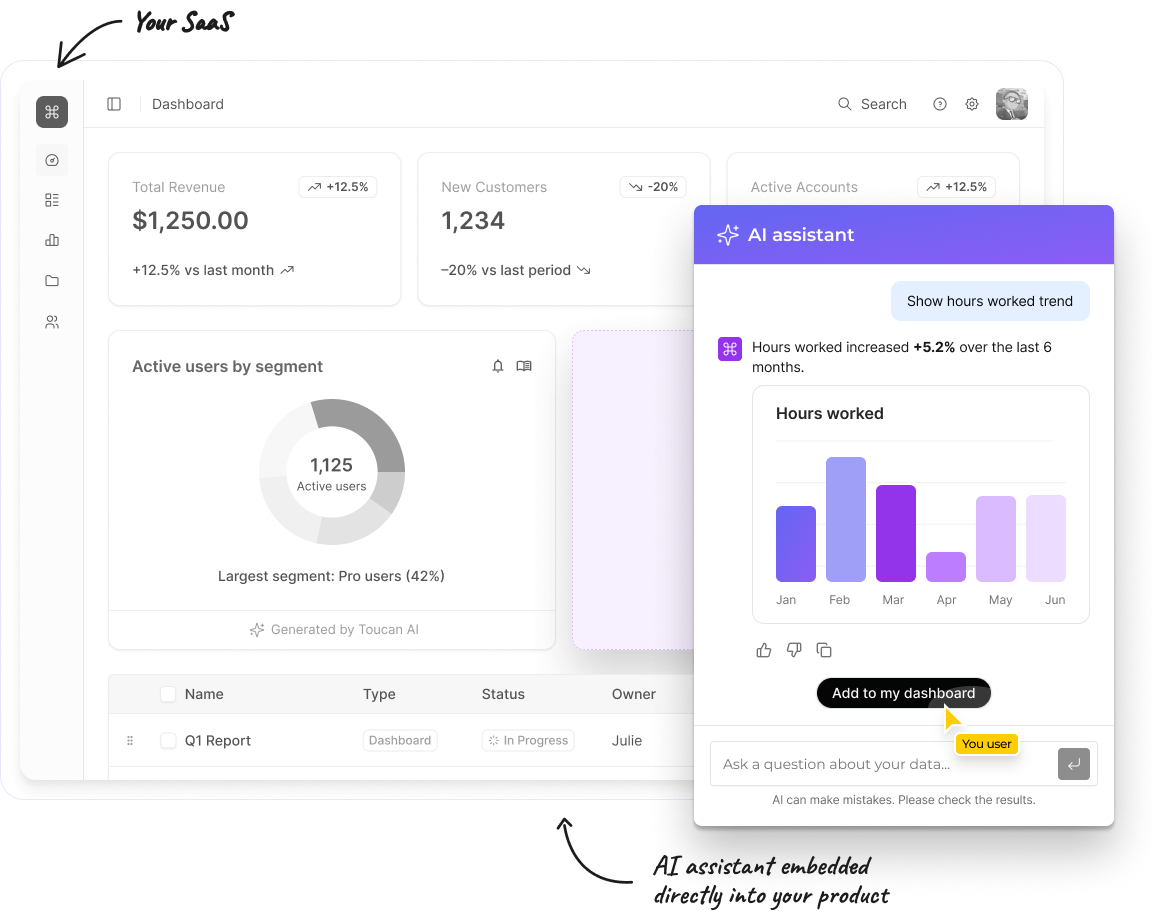
Toucan AI is an AI-native embedded analytics chat built to help SaaS companies integrate analytics directly into their product. With a semantic layer and natural language question-to-chart capabilities, Toucan AI allows customers to easily explore their data and understand what’s happening without needing technical skills by conversing in a chat.
You can request your access :)
Measuring What Matters
What metrics or KPIs do you focus on to measure the ROI and business impact of AI in your product?
We keep it simple and tied to business outcomes:
-
For email routing: the assignation rate. Are emails getting to the right person consistently and rapidly enough?
-
For calls: customer satisfaction rate. Are customers having good experiences with AI-assisted or AI-handled calls?
We're not measuring AI for AI's sake. We're measuring whether it's solving the problems we built it to solve.
Pitfalls to Avoid
From your experience, what are the biggest pitfalls organizations face when adopting AI, and how can they be avoided?
I see two major pitfalls:
1. Talking too much about AI without implementing any first use cases. Endless strategic discussions, frameworks, and planning sessions while nothing actually ships. You learn by doing, not by planning.
2. Key deciders not onboarded (CEO, CPO, CTO, etc.) or willing to keep working the old way. If leadership doesn't understand or embrace AI, you'll hit a ceiling quickly. They'll block budget, resist process changes, or deprioritize AI initiatives.
The Road Ahead
What role will AI play in your product roadmap over the next 2–3 years?
A major enabler to do more with less. As economic pressure increases and growth expectations remain high, AI becomes the way to maintain or expand capabilities without proportionally scaling teams.
Tool of the Moment
What AI tool or technology has recently impressed you, and why?
Lovable helped me build a functional real app ‘Sundrop’ for about $100 without knowing how to code. That would have taken several weeks with a team of three developers, a PM and a Product Designer.
The speed and accessibility is remarkable. It's not just about saving money, it's about the ability to test ideas and validate concepts before committing significant resources.
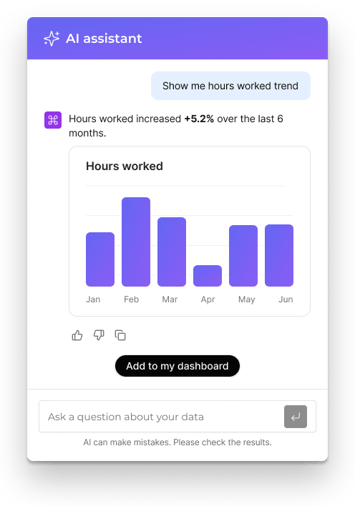
Toucan is an embedded chat powered by AI to ask in plain text your data and get instant charts and insights. Toucan is fully white label to match your brand.
Advice for CPOs
What advice would you give to a CPO beginning their AI journey today?
Free your agenda and spend entire days and nights mastering the basics, how everything works and fits together. It will unlock AI potential for your company and your teams.
And build your own little app you always dreamt of to unveil how AI will impact the engineering (and product) worlds. You need to experience it firsthand to truly understand the implications.
Doing product with AI is very different than without. Bandwidth will not be a problem anymore, you can implement and deploy very quickly. You now need to spend more time on discovery and conception, on problem-statement and what exactly to build to keep focused.
The bottleneck shifts from "can we build this?" to "should we build this?" and that changes everything about how you approach product development.
About Toucan AI
Want to Add Analytics to Your Product Without the Complexity?
Quentin's story at Manda shows how AI can solve real operational bottlenecks. But as product teams ship faster and rely more on data, one challenge remains: giving users access to insights directly inside the product, without requiring technical skills.
That's exactly what Toucan AI is built for. An AI-native embedded analytics chat, Toucan AI helps SaaS companies integrate analytics directly into their product. Thanks to a semantic layer and natural language question-to-chart capabilities, users can simply ask questions in plain language and get instant visual answers, without writing a single query.
For product teams, this means faster shipping, simpler integration, and an analytics experience that drives higher adoption, better retention, and new revenue opportunities.