Building AI-First Products at Scale - Manoj Donga, MD at Tuvoc Interview

Alim Goulamhoussen
Publié le 25.02.26
6 min
This article is part of our CPO x AI interview series, where we explore how product leaders across the tech industry are integrating artificial intelligence into their products and teams. Today, we're speaking with Manoj Donga about his experience at Tuvoc Technologies.
Tuvoc Technologies is a product engineering company with over 150 engineers specializing in AI, Python, MERN, .NET, and UI/UX. They've built deep expertise in specific domains: AdTech, FinTech, and specialized software for the jewelry industry.
Manoj Donga is the Managing Director at Tuvoc Technologies with over two decades of experience across product engineering. His work focuses on scalable architecture, applied AI, and building software platforms for global clients.
We sat down with Manoj to discuss how Tuvoc transformed from AI experimentation to an AI-first organization, and what that shift means for product development at scale.
.png?width=1200&height=627&name=blog%20linkedin%20(13).png)
First Impressions
When you first encountered AI in product development, what was your initial reaction, and how did your team approach it?
About three years ago, we hired our first AI lead. At that point, the decision was partly influenced by the broader industry trend, but once we began experimenting internally, we quickly saw the practical potential.
Our first real implementation was within our in-house lead generation product, where we built an optimal bidding model. That became the starting point of our hands-on AI journey. It wasn't just a proof of concept, it was solving a real business problem.
Soon after, we applied similar thinking to client problems, including building a chatbot for a UK-based FinTech client to reduce manual intervention in customer interactions.
What began as exploration gradually became a structured capability as we started seeing measurable results. The key was moving beyond experimentation into production systems where the impact was undeniable.
A Shifting Landscape
What specific changes have you seen in your product or team in response to these evolving perceptions?
The biggest change has been a clear shift from treating AI as something peripheral to adopting a genuinely AI-first approach.
Earlier, AI was seen as valuable but optional. Today, it is embedded in how we design and build products.
"Teams naturally think about AI as part of the solution rather than an add-on."
It's become part of the default toolkit, not a special case.
That shift has influenced how we plan projects, design workflows, and approach problem-solving across the organization. The conversation changed from "should we use AI here?" to "how should we use AI here?"

Use Cases That Actually Matter
Which specific AI use cases have had the most tangible impact on your product or customers?
One of the most impactful implementations has been our machine learning model for optimal ad bidding, which analyzes requests at a granular level and recommends the most effective bid value. This directly translates to better ROI for our clients' advertising spend.
We've also built AI models for clients where data privacy was critical. In one case, we developed an in-house model capable of processing millions of documents to answer user queries without exposing sensitive data externally. This was particularly important for financial services clients who couldn't risk data leaving their infrastructure.
In addition, AI-driven chatbots have helped clients reduce manual call center workloads and improve response efficiency. The operational savings are immediate and measurable.
Across these use cases, the impact has been very visible in terms of operational improvements and performance gains.
Impact on Delivery
In what ways has AI altered your team's approach to prioritization, testing, and delivery of features?
AI has significantly compressed development timelines. For instance, projects that previously required around 400 hours can now often be delivered in close to a quarter of that time. That's not a marginal improvement, that's transformational.
Teams now plan delivery with AI tools as active contributors in the development process, and we define upfront which platforms will be used alongside engineering resources. AI is factored into project plans from day one, not bolted on later.
This has improved speed, documentation quality, and consistency, while allowing teams to focus more on solving problems rather than repetitive work. The cognitive load shifts from "how do I write this boilerplate" to "what's the right architecture for this problem?"
New Skills, New Expectations
What new roles or skills have become essential within your team?
Prompt engineering has become an important skill across the team. While AI tools are powerful, their effectiveness depends heavily on how clearly problems are framed.
"We invested in internal training sessions to help teams understand how to interact with AI systems more effectively."
Developers have learned through hands-on experience how to integrate these tools into their workflows.
There's been a noticeable shift toward developers thinking more about problem framing rather than just execution. The best developers are now the ones who can articulate problems clearly and structure solutions intelligently, not just the ones who can write the most code.
The Stack
What does your current product and AI stack look like?
Our approach is to combine in-house models with third-party platforms depending on the use case.
We work with tools such as Replit, Lovable, and leading generative AI platforms to accelerate development while building custom models where data privacy or domain specificity requires deeper control.
The stack is intentionally flexible. We prefer choosing the right combination of tools for the problem rather than committing to a single approach. Dogmatism about technology choices is a luxury we can't afford when client needs vary so widely.
Build vs. Buy
How do you decide between choosing to build in-house or integrate a third-party AI solution?
The decision really comes down to the nature of the problem and data sensitivity.
"If speed and standard capabilities are the priority, integrating third-party APIs is usually the most efficient path."
But when data privacy is critical, or the solution requires domain-specific intelligence, we build models in-house and keep data within the client's infrastructure.
Ultimately, the choice is always driven by the use case rather than a fixed preference. We've seen both approaches work brilliantly, and we've seen both fail when applied incorrectly.
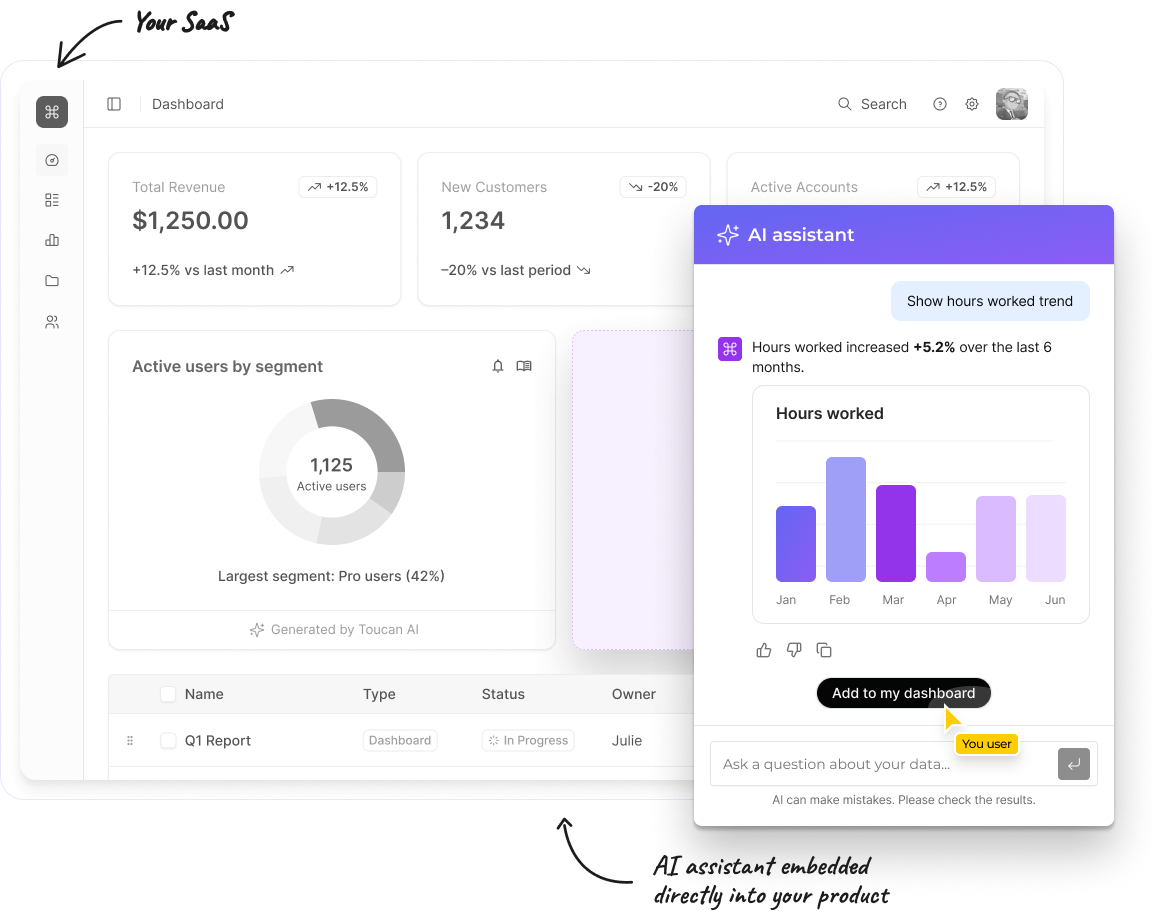
Toucan AI is an AI-native embedded analytics chat built to help SaaS companies integrate analytics directly into their product. With a semantic layer and natural language question-to-chart capabilities, Toucan AI allows customers to easily explore their data and understand what’s happening without needing technical skills by conversing in a chat.
You can request your access :)
Measuring What Matters
What metrics or KPIs do you focus on to measure the ROI and business impact of AI in your product?
We look closely at improvements in operational efficiency. AI is particularly effective in reducing or eliminating manual tasks, which has a direct impact on productivity.
We also evaluate how AI supports decision-making through machine learning models that provide recommendations to stakeholders, helping them make more informed choices. It's not just about automation, it's about augmentation.
In some cases, we've also seen cost optimization, including reductions in infrastructure usage, which is another clear indicator of impact. When you can deliver the same results with fewer resources, that's tangible ROI.
Pitfalls to Avoid
From your experience, what are the biggest pitfalls organizations face when adopting AI, and how can they be avoided?
One of the most common pitfalls is overcommitting on accuracy expectations. Unlike traditional software, AI systems are probabilistic and depend heavily on data quality.
Teams often assume they can guarantee near-perfect accuracy from the start, but in reality, performance improves through iteration and learning. AI is fundamentally different from deterministic software, and managing stakeholder expectations around that is critical.
"Setting realistic expectations and allowing models to evolve over time is key, rather than treating AI as deterministic software."
The first version will rarely be the best version.
The Road Ahead
What role will AI play in your product roadmap over the next 2–3 years?
AI has clearly moved from being a peripheral feature to becoming a core part of product design.
We expect it to play a central role in decision-making, operational workflows, and user experience across products. Future roadmaps increasingly assume AI as a foundational capability rather than an enhancement.
The question is no longer "will we use AI?" but "how deeply can we embed it?"
Tool of the Moment
What AI tool or technology has recently impressed you, and why?
Tools like Lovable have been particularly impressive because they can generate functional MVPs very quickly, which significantly accelerates early product validation. The speed at which you can go from idea to working prototype is remarkable.
Platforms like Replit also help streamline development workflows and improve productivity across teams.
While new tools continue to emerge, these have stood out for their practical impact on delivery speed. It's not about novelty, it's about what actually works in production.
Advice for CPOs
What advice would you give to a CPO beginning their AI journey today?
The biggest shift is to think of AI as a core component of product design rather than an optional feature.
Products should be designed to minimize manual operations and leverage AI to support decision-making wherever possible. Leaders who embed AI thinking early in their strategy will be better positioned to build scalable and efficient products.
Don't treat it as a side project or an experiment. Make it foundational to how you think about building products.
About Toucan
Manoj's experience at Tuvoc shows how AI can transform product development at scale. But as teams ship faster and products become more data-driven, one challenge remains: giving users access to insights directly inside the product, without requiring technical skills.
That's exactly what Toucan AI is built for. An AI-native embedded analytics chat, Toucan AI helps SaaS companies integrate analytics directly into their product. Thanks to a semantic layer and natural language question-to-chart capabilities, users can simply ask questions in plain language and get instant visual answers, without writing a single query.
For product teams, this means faster shipping, simpler integration, and an analytics experience that drives higher adoption, better retention, and new revenue opportunities.
You can request your access :)