From AI Hype to Real Impact: LeadSeed's Strategic Approach

Alim Goulamhoussen
Publié le 25.02.26
6 min
This article is part of our CPO x AI interview series, where we explore how product leaders across the tech industry are integrating artificial intelligence into their products and teams. Today, we're speaking with Mohamed Hamdouni about his experience at LeadSeed.
LeadSeed is a B2B SaaS platform that transforms how companies engage prospects and customers. By combining interactive data collection with AI-powered personalization, they help businesses generate qualified leads and create individualized content at scale.
Mohamed Hamdouni leads product and innovation. His role sits at the intersection of product strategy, customer understanding, and execution.
.png?width=797&height=416&name=blog%20linkedin%20(15).png)
First impressions
When you first encountered AI in product development, what was your initial reaction, and how did your team approach it?
My first reaction (2022) wasn't excitement. It was curiosity mixed with strategic caution.
I immediately saw the leverage potential, but I also knew that hype can destroy focus. Too many teams were jumping on AI without understanding why or how it would actually move the needle.
Instead of starting with "how do we add AI?", I started with:
- Where are we losing time?
- Where is decision-making slow or imperfect?
- Where are customers experiencing friction?
"Then I treated AI as an optimization layer, not a feature."
The team's approach was deliberate and disciplined. We identified repeatable cognitive tasks (we do a lot of consulting as service for our customers). We prototyped fast with external tools (vibe coding). And we measured real impact for our business and customers before committing engineering resources.
We avoided building prematurely. We experimented first. This saved us from wasting months on AI features that looked impressive in demos but didn't solve real problems.
A shifting landscape
What specific changes have you seen in your product or team in response to these evolving perceptions?
As perceptions of AI shifted from hype to strategic capability, we made several concrete changes.
First, at the product level, we stopped treating AI as a feature and started embedding it as a layer across workflows. Instead of asking "Where can we add AI?", we now ask "Where can intelligence improve speed or decision quality or reduce friction?"
Second, in the team, we invested in AI literacy and prototyping. All collaborators are now expected to understand AI capabilities, limitations, and trade-offs. The conversations have become more data-driven and experimentation-focused. Everyone needs to understand what AI can and cannot do, not just the technical team.
Third, our delivery approach evolved. We ship AI features progressively, monitor performance continuously, and design human-in-the-loop mechanisms when needed. We're more comfortable working with probabilistic systems and iterating based on real-world behavior.
"Overall, the biggest change is cultural: AI is no longer a tool we test occasionally or a chat assistant, it's becoming part of how we think about building products."
Use cases that actually matter
Which specific AI use cases have had the most tangible impact on your product or customers?
The most tangible impact came from use cases that weren't flashy but solved real problems:
-
Process acceleration: Reducing internal operational bottlenecks that were slowing down our ability to serve customers efficiently.
-
Content generation and personalization at scale: Allowing us to create individualized, relevant content for each prospect without manual effort.
-
Consulting-support tools: Augmenting human judgment rather than replacing it. Our team still makes the strategic decisions, but AI handles the heavy lifting.
-
End customer contextualization and scoring models: Helping customers prioritize high-value content and focus their efforts where they'll get the best returns.
The key impact wasn't "wow effect." It was shorter cycle times (consulting, setup and broadcast), seamless integration, and more consistent and valuable output quality. Real business metrics, not demo magic.
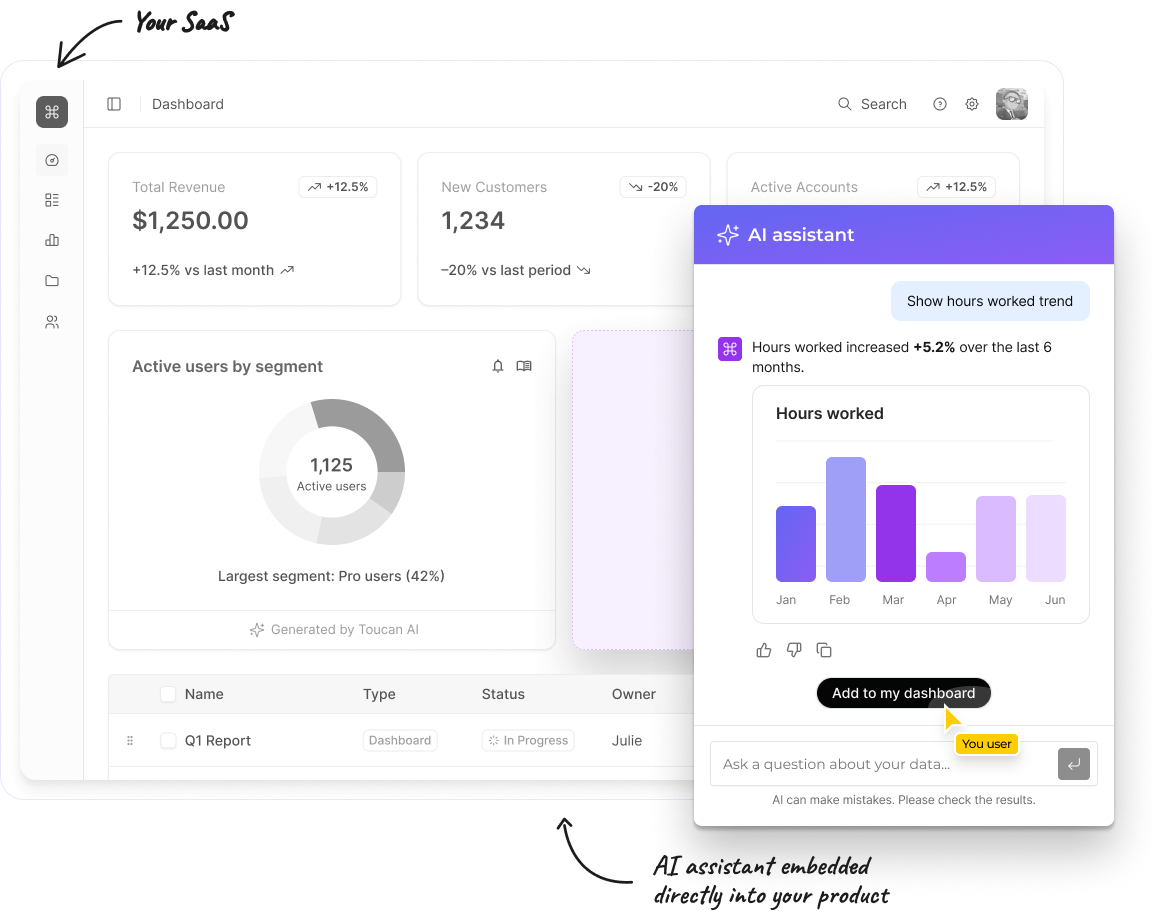
Toucan AI is an AI-native embedded analytics chat built to help SaaS companies integrate analytics directly into their product. With a semantic layer and natural language question-to-chart capabilities, Toucan AI allows customers to easily explore their data and understand what’s happening without needing technical skills by conversing in a chat.
You can request your access :)
Impact on delivery
In what ways has AI altered your team's approach to prioritization, testing, and delivery of features?
AI changed our mindset from "Ship a feature" to "Design an evolving system."
Three major shifts happened:
Prioritization We now evaluate projects differently. We assess data availability, model adaptability, and long-term evolution potential. Not just effort vs impact. The questions changed.
Testing We test fundamentally different things now. Output quality variability, edge cases and internal beta testing, human-AI interaction friction. AI models A/B testing is fundamentally different from testing deterministic features. You're testing probability distributions, not binary outcomes.
Delivery We ship faster but with staged exposure. This includes customer training, human-in-the-loop validation, and a continuous retraining mindset. We don't ship and forget, we ship and monitor and improve.
New skills, new expectations
What new roles or skills have become essential within your team?
Not necessarily new titles, but new capabilities across the team:
-
AI literacy across all teams: I'm the evangelist when it comes to AI, and I try to keep the teams constantly up-to-date. This isn't optional anymore.
-
Prompt engineering mindset: Mainly based on CREATE and CO-STAR prompting structures. Knowing how to communicate with AI systems effectively is now a core skill.
-
Models and data evaluation and critical thinking: Understanding when outputs are good enough versus when they need human intervention.
-
Ethical risk and compliance assessment: Especially important in B2B SaaS where customer data is involved.
-
Ability to work with probabilistic and multimodal systems: Moving beyond deterministic thinking.
The most important shift: Comfort with uncertainty. 😅 Not every AI output will be perfect, and that's okay if you design the right guardrails.
The stack
What does your current product and AI stack look like?
Our product stack is built for flexibility and fast iteration, with a modern SaaS architecture, API-driven integrations, and a data layer that supports real-time personalization and analytics.
On the AI side, we use a hybrid approach. We integrate large language models via APIs for content generation and dynamic interactions, while keeping our core business logic and methodology, data control, and scoring models in-house.
AI is embedded into workflows rather than treated as a standalone feature. It's part of the product fabric, not a bolt-on.
We prioritize tools that deliver measurable business impact, remain maintainable, and support our long-term strategic differentiation.

Build vs. Buy
How do you decide between choosing to build in-house or integrate a third-party AI solution?
As we are a B2B SaaS company, we decide based on strategic value, speed, and long-term ownership.
If the capability is core to our competitive differentiation or relies heavily on proprietary data and IP (Intellectual Property), we lean toward building in-house. That gives us control and protects our long-term advantage.
If the goal is speed, experimentation, or accessing state-of-the-art performance, we integrate third-party solutions first (like we did back in 2022 with DeepL, an AI-based translation tool). It allows us to validate impact quickly without committing heavy resources.
We usually start by integrating, measure real business value, and only move to in-house development if the use case proves strategic and sustainable. Prove it first, then own it.
Measuring what matters
What metrics or KPIs do you focus on to measure the ROI and business impact of AI in your product?
I divide metrics into three layers:
Operational
- Time saved
- Cost reduction
- Process acceleration
Product
- Feature adoption rate
- Retention impact
- Task completion and conversion rates
Strategic
- Revenue uplift
- Customer satisfaction
- Reduction in churn
If AI doesn't move at least one of these levers measurably, it's not strategic. It's cosmetic.
Pitfalls to avoid
From your experience, what are the biggest pitfalls organizations face when adopting AI, and how can they be avoided?
Building for hype Advice: Tie every initiative to measurable product and business values. No exceptions.
Underestimating data quality Advice: I always tell our team "Garbage in, amplified garbage out" when it comes to AI. Data quality is everything.
Ignoring change management Advice: AI adoption is cultural, not technical. If your team doesn't understand or trust the AI, it won't get used.
Treating AI as static software Advice: Models degrade. Monitoring and evaluations are mandatory at every step. You can't ship AI and walk away.
To make it short, to avoid these pitfalls: governance + experimentation + discipline.
The road ahead
What role will AI play in your product roadmap over the next 2–3 years?
In the next 2-3 years, I see several major shifts:
AI-powered personalization as default: Vibe coding-like experiences where every user gets contextually relevant content.
Predictive workflows: We collect a lot of valuable data and we must be able to leverage them to predict campaigns results and value before they even launch.
Semi-autonomous product capabilities: Especially in data enrichment and campaigns analysis, where AI can handle routine decisions.
AI copilots integrated into core user journeys: To help users get the most of every single information and KPI, making complex data accessible and actionable.
The competitive advantage will not lie in possessing AI. It will be about designing products that are inherently adaptive, particularly to the speed at which things are evolving.
Tool of the moment
What AI tool or technology has recently impressed you, and why?
Large multimodal models and Agentic systems have impressed me the most, particularly systems that combine reasoning, autonomy, generation, and contextual memory.
What's impressive isn't just performance, it's the convergence of capabilities: text, vision, structured data, and workflow automation all working together.
We're moving from tools to cognitive platforms. That's a fundamental shift in what's possible.
Advice for CPOs
What advice would you give to a CPO beginning their AI journey today?
- Don't start with technology. Start with bottlenecks.
- Build AI literacy inside your product team.
- Prototype before budgeting.
- Measure everything.
- Treat AI as a strategic capability, not a feature add-on.
- Design governance early.
- Accept probabilistic behavior and design strong guardrails.
And most importantly: AI is not about replacing people. It's about augmenting leverage.
In terms of solution, as a CPO, your role is making AI insights accessible to everyone. AI should not be confined to data scientists or technical teams.
To democratize AI insights:
- Build simple interfaces (you can now easily prototype and test)
- Always keep human in the loop
- Visualize outputs clearly
- Provide explainability layers
- Educate teams continuously
- Encourage experimentation culture
- Last but not least: Experiment, experiment, experiment...
The real transformation happens when non-technical stakeholders feel empowered to use AI confidently.
About Toucan
Toucan AI is an AI-native embedded analytics chat. It allows SaaS companies integrate analytics directly into their product. Thanks to a semantic layer and natural language question-to-chart capabilities, users can simply ask questions in plain language and get instant visual answers, without writing a single query.
For product teams, this means faster shipping, simpler integration, and an analytics experience that drives higher adoption, better retention, and new revenue opportunities.
You can request your access :)