Tableau Pricing 2026: The Complete Cost Breakdown

Alim Goulamhoussen
Publié le 07.05.26
Mis à jour le 02.06.26
10 min
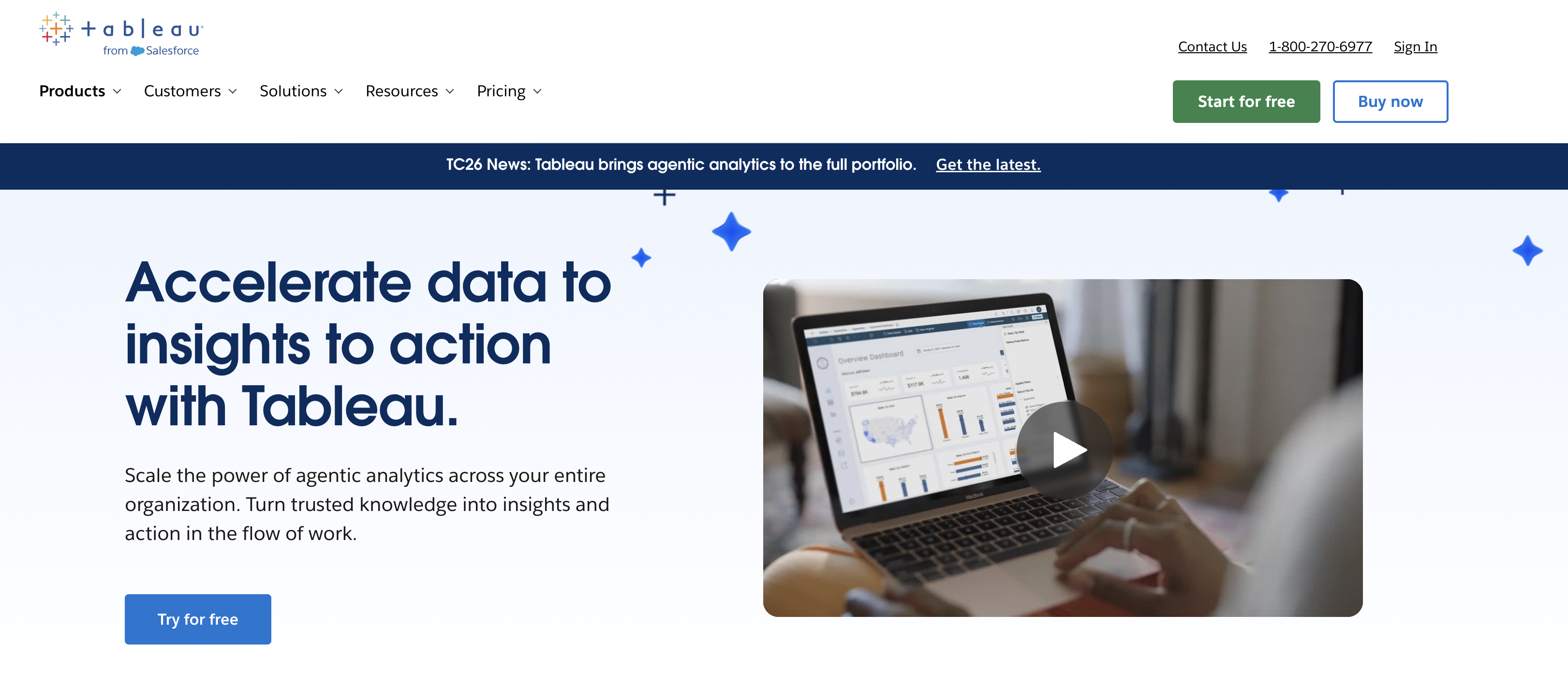
Tableau starts at $15 per user per month. That is the number people remember from the pricing page. The one that makes it look like a manageable line item in a software budget.
Then the quote comes in. And it is very rarely $15 per user per month.
Tableau's pricing structure was designed for enterprise data teams. If you are a CPO or CTO at an ISV evaluating Tableau Embedded Analytics to ship analytics inside your product, you are looking at a completely different cost structure, a separate licensing model, and a set of architectural tradeoffs that most pricing guides do not explain clearly.
This article breaks down every Tableau tier, the real cost of Tableau Embedded for ISVs, what the hidden fees are, and whether there is a faster path to shipping customer-facing analytics.
Tableau Pricing in 2026: Every Plan at a Glance
Tableau offers two main deployment options: Tableau Cloud (fully hosted by Salesforce) and Tableau Server (self-managed on your own infrastructure). Both support three user types. The price is different depending on which product you choose.
|
User Type |
Tableau Cloud (Standard) |
Tableau Cloud (Enterprise) |
What They Can Do |
|
Viewer |
$15/user/mo |
$35/user/mo |
View and interact with dashboards. No editing. |
|
Explorer |
$42/user/mo |
$70/user/mo |
Explore and edit existing workbooks. Limited authoring. |
|
Creator |
$75/user/mo |
$115/user/mo |
Full access: Desktop, Prep, data connections, dashboard creation. |
Every deployment requires at least one Creator license. All plans are billed annually. There is no month-to-month option at standard pricing.
One thing that surprises many buyers: the difference between Standard and Enterprise is not just features. Most mid-to-large organizations end up on Enterprise pricing once they need advanced governance, Tableau Pulse (the AI analytics layer), or advanced management controls. That means the $15/viewer entry point quickly becomes $35/viewer.
Tableau+ and Tableau Next: The AI Tier
Salesforce has introduced Tableau+ as a bundle exclusive to Tableau Cloud that includes Tableau Next and agentic analytics capabilities. Pricing for Tableau+ is not publicly listed. You need to contact sales. Based on market reports, Tableau+ significantly exceeds standard Tableau Cloud pricing.
If AI-driven insights or natural language querying are part of your evaluation criteria, expect this to be a meaningful additional line item, not a feature that comes with your standard license.
Tableau Server: When You Host It Yourself
Tableau Server is the self-managed deployment option. The per-user license costs are the same as Tableau Cloud, but you also carry infrastructure costs: server hardware or cloud VM hosting, database licenses, backup and disaster recovery, and network bandwidth. Organizations typically budget 20 to 40% of license costs for infrastructure in the first year. Annual server maintenance runs 17 to 22% of license fees on top of that.
What Tableau Embedded Analytics Actually Costs
If you are an ISV who wants to embed Tableau dashboards inside your product for your customers, you are not buying standard Tableau. You need Tableau Embedded Analytics, which has its own pricing model and its own set of constraints.
Tableau does not publish pricing for embedded deployments. You have to talk to sales. But here is what independent research and ISV communities have surfaced.
The Per-User Problem for ISVs
In a standard Tableau deployment, you pay per named user inside your organization. In an embedded deployment, you pay per viewer who accesses your application. If your SaaS product serves 500 customers and each has 5 users who look at dashboards, you are looking at 2,500 viewer seats.
At $35/viewer/year for the embedded viewer tier (reported by multiple independent sources), that is $87,500 per year in viewer licenses alone. Before you count Creator licenses for your own team, infrastructure, training, or support.
The Tableau Embedded Analytics creator license for developers is reported at $115/user/month. Every developer who builds or maintains embedded dashboards needs one.
|
License Type (Embedded) |
Reported Cost |
Who Needs It |
|
Embedded Creator |
~$115/user/mo |
Your developers building and maintaining dashboards |
|
Embedded Explorer |
~$70/user/mo |
Internal team members who edit existing dashboards |
|
Embedded Viewer |
~$35/user/mo (or ~$420/user/year) |
Your customers viewing dashboards inside your product |
Embedded pricing is not published by Tableau. Figures above are based on reports from ISV communities, G2 reviews, and independent pricing research. Always request a formal quote before budgeting.
The Startup Reality Check
One public G2 review captures what many ISVs discover during procurement: "Tableau quoted $131k/year for guest access. We're a 10-person startup. This model is absurd."
Another documented case: support fees jumping from 20% to 40% at renewal, combined with mandatory training, making Tableau 60% more expensive year-over-year than the initial contract suggested.
These are not edge cases. They reflect a pricing model designed for enterprise software procurement, not for growing ISVs who need cost predictability as their customer base scales.
The Hidden Costs That Do Not Appear in Any Tableau Quote
The license fees are the visible part. Here is what accumulates on top.
Training and Certification
Tableau has a significant learning curve. Most organizations budget 2 to 4 weeks of training per Creator user. Official Tableau training courses run $1,500 to $3,000 per person. For a 5-person data team, that is $7,500 to $15,000 in training costs before anyone has built a single dashboard. The Desktop Specialist certification adds $100 per exam, after completing training.
Data Preparation
Tableau connects to your data. It does not clean it. Before analysts can build anything, someone needs to set up pipelines, handle transformations, and maintain data quality. Tableau Prep Builder is included with Creator licenses only. Teams that need broader data preparation often end up adding tools like dbt, Fivetran, or Alteryx (from $5,195/year per user) alongside Tableau.
According to Gartner, analysts spend up to 80% of their time on data preparation. That figure matters when you are paying $75 to $115 per Creator per month and most of their time is not spent building dashboards.
Infrastructure (Tableau Server)
If you go the self-hosted route, add dedicated server costs ($15,000 to $50,000/year depending on scale), database licenses, backup infrastructure, and IT staff to manage it. Tableau Server maintenance runs 17 to 22% of license fees annually on top of that.
Premium Support
Standard support is included. Premium support tiers with faster response times and dedicated resources are separate. Organizations report support fee structures that can reach 40% of license cost at renewal, particularly once the initial contract term ends.
Multi-Year Contract Lock-In
Volume discounts and meaningful pricing concessions at Tableau typically require multi-year commitments. Single-year deals often cost 20 to 30% more. Organizations that negotiate aggressively with competitive alternatives in hand frequently secure better terms, but the process requires time and leverage that not every ISV has during a procurement cycle.
The Scaling Trap
Tableau's per-user model is transparent and predictable for internal teams where headcount is fixed. It becomes a growth tax when applied to customer-facing analytics.
|
Scenario |
Annual viewer license cost |
|
100 customer users accessing embedded dashboards |
~$42,000/year |
|
500 customer users accessing embedded dashboards |
~$210,000/year |
|
2,000 customer users accessing embedded dashboards |
~$840,000/year |
Every new customer you close, every new user inside an existing customer account: each one adds to your Tableau invoice. Your analytics cost scales directly with your product's success. That is a structural problem for any ISV trying to maintain healthy unit economics.

What Tableau Embedded Does Not Do Well for ISVs
Tableau is a powerful product. It was built for data analysts inside large organizations who need rich visual exploration capabilities. That is genuinely valuable for the right use case. But several characteristics of Tableau's architecture create friction for ISVs specifically.
No Native White-Label
Tableau's embed options produce dashboards that look like Tableau. The Salesforce and Tableau visual identity does not disappear when you embed via iframe or JavaScript. Achieving complete white-label where your customers see only your brand requires significant custom front-end engineering. Some ISVs manage it. It is not the default state.
No Native Multi-Tenancy
Serving 100 customers with isolated data means managing 100 separate content structures. Tableau does not handle multi-tenancy automatically. ISVs typically implement this through separate sites or content hierarchies with row-level security, which requires scripting and maintenance as the customer base grows. Teams that build this for 20 customers often find the architecture unmanageable at 200.
Analyst-First UX
Tableau's creator experience is designed for people who are comfortable with data. The visualization breadth is impressive. But your product's end customers are rarely data analysts. A platform with 50 chart types and deep customization options is often more than non-technical users need, and the complexity can reduce adoption. Research consistently shows 60 to 80% of BI dashboards go unused after the first month. Tableau's flexibility becomes a liability when the goal is adoption by non-expert users.
Pricing Opacity for Embedded
Standard Tableau pricing is published. Embedded Analytics pricing is not. Every ISV goes through a custom sales process. That opacity makes benchmarking difficult, budget planning imprecise, and renewals harder to predict.
Who Should Actually Use Tableau Embedded Analytics
Being direct about this: Tableau Embedded is the right answer for a specific type of ISV. It is the wrong answer for a larger, more common one.
Tableau Embedded makes sense if you:
- Are already deeply in the Salesforce ecosystem and your data team works in Tableau daily
- Have a mature enterprise customer base where rich visual exploration is genuinely expected
- Have the engineering capacity to build and maintain the white-label and multi-tenancy layer on top of Tableau
- Have budget above $100,000/year for analytics infrastructure and can absorb per-viewer cost growth
- Your customers are enterprise users comfortable with complex analytics tools
Tableau Embedded is probably not the right fit if you:
- Need predictable analytics costs as your customer base grows
- Want a full white-label experience where your product looks like your product, by default
- Are a growing ISV without a dedicated BI engineering team
- Need non-technical product managers or ops teams to build and iterate on dashboards without SQL
- Want to ship customer-facing analytics in weeks, not quarters
Tableau vs Toucan: A Direct Comparison for ISVs
Toucan is a purpose-built embedded analytics platform for ISVs. Unlike Tableau, it was designed from the start for customer-facing deployments: multi-tenant by default, fully white-labeled, with a no-code builder that product and ops teams can use without engineering support.
Here is how the two compare on the criteria that matter for an ISV product team:
|
|
Tableau Embedded |
Toucan |
|
Pricing model |
Per viewer (scales with customer base) |
Flat subscription (predictable) |
|
Pricing transparency |
Not published, custom quote required |
Published pricing, from $890/mo |
|
White-label |
Partial (requires custom engineering) |
Native, full brand control |
|
Multi-tenancy |
Manual (scripting + RLS per customer) |
Native, built-in tenant isolation |
|
No-code builder |
No (requires VizQL / Tableau expertise) |
Yes, product and ops teams can build |
|
AI analytics (NLQ) |
Tableau+ only (premium tier, no public price) |
Conversational AI on governed semantic model |
|
Integration time |
4-8 weeks (engineering required) |
Days, no dedicated BI team needed |
|
Cost as you scale |
Grows with every new customer user |
Fixed, does not scale with end-user count |
|
Deployment options |
Cloud or self-managed Server |
SaaS or self-hosted (Docker-based) |
A Real-World Cost Scenario: ISV with 150 Customer Tenants
Scenario: a growing ISV, 150 customer tenants, average 10 dashboard viewers per customer (1,500 total end users), 3 internal creators building and maintaining dashboards.
|
Cost Element |
Tableau Embedded (Year 1) |
Toucan (Year 1) |
|
Viewer licenses (1,500 users) |
~$630,000 |
Included in platform fee |
|
Creator licenses (3 builders) |
~$4,140 |
Included |
|
Platform / subscription fee |
Custom (included in viewer cost) |
~$10,680 (annual) |
|
Engineering integration |
~$30,000 (6-8 weeks) |
~$2,500 (a few days) |
|
Training (3 creators) |
~$9,000 |
Minimal |
|
Ongoing maintenance |
~$15,000/year |
Minimal |
|
Total Year 1 estimate |
~$688,140+ |
~$13,180 |
Tableau embedded viewer figures based on reported $420/user/year embedded viewer pricing from independent ISV research. Actual Tableau quotes vary. Always request a formal quote from Tableau sales. Toucan estimates based on published pricing and standard market rates for engineering services.
The gap in this scenario is not surprising. Tableau was not designed for this use case. A per-viewer model that works for an internal team of 200 becomes structurally incompatible with a SaaS product that has thousands of customer-facing users.

Why ISVs Are Choosing Purpose-Built Embedded Analytics
The ISV market has moved toward a category of platforms built specifically for customer-facing analytics: tools where multi-tenancy, white-labeling, and flat pricing are the starting point, not a configuration challenge.
Toucan sits in this category. Here is what that means in practice for an ISV product team:
- Flat pricing, not per-viewer: Your analytics cost does not grow with every customer you close. You can model your unit economics without a Tableau pricing variable in the denominator.
- AI-native analytics layer: Toucan brings conversational, natural language querying directly inside your product. Your customers ask questions, get answers, without needing SQL or BI training. The AI runs on a governed semantic model, so answers are accurate, not hallucinated.
- No-code builder for product teams: Your CPO or ops lead can build and iterate on dashboards without engineering support. That keeps analytics off your sprint backlog.
- Multi-tenant by design: Row-level security and tenant isolation work out of the box. You do not build or maintain the architecture for it.
- Full white-label: Your customers see your brand. Not Tableau, not Salesforce. Your product.
- Deployment flexibility: SaaS or self-hosted via Docker, for teams with data sovereignty or regulatory requirements.
ISVs who switched to Toucan from Tableau Embedded typically report three outcomes: faster time to first embedded dashboard (days vs weeks), lower total cost at scale (fixed vs per-viewer), and higher end-user adoption because the UX is designed for non-technical users, not data analysts.
FAQ: Tableau Pricing
How much does Tableau cost per user in 2026?
Tableau Cloud Standard pricing is $15/user/month for Viewer, $42/user/month for Explorer, and $75/user/month for Creator, billed annually. Tableau Cloud Enterprise pricing is higher: $35/Viewer, $70/Explorer, $115/Creator. Most mid-to-large organizations end up on Enterprise pricing. Tableau Server follows the same per-user structure but adds significant infrastructure costs on top.
Is there a free version of Tableau?
Tableau Public is free but requires all visualizations to be published publicly online. It is not suitable for company data or any confidential analytics. Tableau Desktop has a 14-day free trial. Tableau Desktop Free Edition exists for local analysis of Excel, CSV, and database files, but cannot publish to shared environments. There is no free tier for team or embedded use.
How much does Tableau Embedded Analytics cost for an ISV?
Tableau does not publish embedded pricing. Based on ISV community reports and independent research, embedded viewer licenses run approximately $35/user/month ($420/user/year), with developer Creator licenses at $115/user/month. For an ISV with 1,000 customer-facing users, that is approximately $420,000/year in viewer licenses alone, before creator licenses, training, infrastructure, or support. Always request a formal quote, as pricing varies significantly.
What is the difference between Tableau Cloud and Tableau Server?
Tableau Cloud is the fully hosted SaaS version. Salesforce manages infrastructure, updates, and scaling. Tableau Server is a self-managed deployment you run on your own infrastructure. Tableau Server gives you more control over data sovereignty and security, but adds infrastructure costs (typically 20 to 40% of license fees) and requires dedicated IT resources to maintain. The per-user license prices are the same for both.
What is Tableau+?
Tableau+ is a premium bundle exclusive to Tableau Cloud that includes Tableau Next and agentic analytics capabilities including natural language querying via Tableau Pulse. Pricing is not publicly listed and requires a sales conversation. Tableau+ is the only tier that includes Salesforce's full AI analytics suite. Teams evaluating Tableau for AI-driven insights should request Tableau+ pricing specifically.
Why does Tableau cost more than the listed price?
Several factors drive actual Tableau costs above list pricing: volume discounts require multi-year commitments (single-year contracts run 20 to 30% more); Enterprise features like Tableau Pulse, advanced governance, and Data Management are priced separately or require tier upgrades; training runs $1,500 to $3,000 per Creator; Tableau Server requires separate infrastructure investment; and support fees can escalate significantly at renewal.
What are the best alternatives to Tableau Embedded Analytics for ISVs?
ISVs looking for alternatives to Tableau Embedded typically evaluate purpose-built embedded analytics platforms including Toucan, Luzmo, Explo, and GoodData Embedded. These platforms are designed specifically for customer-facing analytics, offer flat or usage-based pricing that does not scale with end-user count, include native multi-tenancy and white-labeling, and typically ship faster than Tableau Embedded deployments.
The Bottom Line on Tableau Pricing for ISVs
Tableau is one of the most capable analytics platforms in the market. For enterprise organizations with dedicated data teams, deep Salesforce integration, and internal analytics use cases, it earns its price tag. Tableau Embedded Analytics makes sense for ISVs who are already in that Salesforce ecosystem and have the engineering capacity to build a production-grade embedded deployment on top of it.
For the majority of ISVs evaluating embedded analytics today, the per-viewer model is the core problem. Your analytics cost should not grow in direct proportion to your customer base. That is not how SaaS unit economics work.
If you are a product team looking to ship customer-facing analytics in weeks, with a cost structure that scales predictably, the category of purpose-built embedded analytics platforms will give you a faster path than Tableau Embedded.
The best next step is a direct comparison against your specific use case: number of customer tenants, expected viewer counts, deployment requirements, and whether your team has dedicated BI engineering capacity. The math changes significantly based on those inputs.