AI-built dashboard: a prototype, not a product

Alim Goulamhoussen
Publié le 24.09.26
Mis à jour le 01.10.26
6 min
Résumer cet article avec :
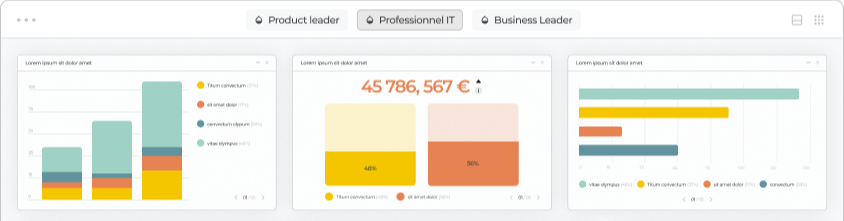
Ask an AI dashboard generator for a sales dashboard and you will have one before your coffee cools. Real data, clean charts, a filter or two. It looks finished.
It is not. It is a prototype, and often a very good one. The trouble starts when a team begins to run on it: a second person opens it and sees different numbers, a definition changes, a source breaks on a Tuesday, and nobody is sure whose job it is to fix it.
This guide explains where the line between a prototype and a product sits, what it takes to cross it, and who can do that work for you.
TL;DR
AI can build a business dashboard from your data in minutes. What it produces is a prototype: good enough to explore, not governed enough to run a team on. A product needs one definition per metric, permissions per person, a real home, someone watching it, someone updating it, and someone who signs off on the numbers.
- Keep using AI to build the first version. It is the fastest brief you will ever write.
- Before a team relies on it, decide who defines, maintains, and signs the numbers.
- If nobody on your side has that job, have the app built and run for you.
Can AI build and maintain a business dashboard from your company data?
It can build one, and it can keep parts of it fresh. It cannot own it. ChatGPT, Claude, and dedicated AI dashboard generators connect to your sources, write the queries, and draw the charts in minutes. Claude can publish a dashboard that reloads data each time it is opened. ChatGPT Work's Data agent builds dashboards teammates can edit, share, and refresh.
Maintenance is where the claim gets thin. Refreshing data is the easy part. The hard part is keeping the dashboard right: updating a metric when the business redefines it, fixing a view when a source schema changes, catching a number that looks plausible and is wrong, and answering for it in a meeting.
AI can help with each of those steps. It still needs someone to decide, check, and sign. That someone is the difference between a prototype and a product.
What is the difference between a dashboard prototype and a production dashboard?
A dashboard prototype is a working first version built to explore a question: real data, real charts, no guarantees. A production dashboard is an operated app a team makes decisions from every week, with metrics defined once, permissions per person, views shaped to how the business decides, someone who maintains it, and someone accountable for every number. The charts can look identical. What differs is everything around them.
| Prototype AI-built |
Product Built and operated |
|
|---|---|---|
| Built for | One person exploring a question | A team deciding every week |
| Views | The charts the model picks | Bespoke views shaped to your decisions |
| Metric definitions | Whatever the prompt resolved that day | Defined once, shared by everyone |
| Permissions | Each viewer's own access | Row-level security: each person sees their slice |
| Where it lives | A chat workspace | Your app, one place your team logs into |
| When a source changes | It breaks quietly | Someone notices and fixes it |
| New questions | You re-prompt | Requests go into a tested release |
| Who signs the numbers | Nobody | A named person |
Notice what is not on the list: speed, chart quality, or raw intelligence. AI wins those. The gap is operational, which is why a better model does not close it.
Why does an AI-built dashboard feel finished when it is not?
Because the part you can see is the part AI does best. Layout, charts, a tidy written summary: all visible in the first ten minutes.
The work that makes a dashboard dependable is invisible on day one. Nobody sees a missing metric definition until two teams bring different revenue figures to the same meeting. Nobody sees a missing permission model until a regional manager opens data meant for finance.
There is also a timing trap. The demo happens at peak accuracy, on the data you just connected, answering the question you just asked. Maintenance starts the week after. That is when a prototype either gets an owner or starts to drift. We break down what that drift costs in hours in the hidden cost of DIY AI analytics.
What does it take to turn an AI dashboard prototype into a product?
Six things, and none of them is a better prompt.
-
One definition per metric. Revenue, active customer, churn: written once, in a semantic layer every view reads from.
-
Permissions per person. Row-level security, so a regional lead sees their region and finance sees everything.
-
A real home. A deployed app your team logs into. On Claude, a shared dashboard loads data through each viewer's own connectors, so two people can see different numbers.
-
Monitoring. Someone who notices when a refresh fails or a number moves for the wrong reason.
-
A change process. New questions and new definitions go into a release, checked before anyone sees them.
-
Sign-off. A named person reviews each release and stands behind the figures.
If your company already runs a warehouse, a semantic layer, and a data team, most of this exists, and AI sits nicely on top. ChatGPT's Data agent is designed for exactly that setup, as we explain in ChatGPT for data analysis: what works, what breaks. If those foundations do not exist, the prototype is sitting on nothing.
Who should maintain an AI-built business dashboard?
Someone has to. There are three realistic options, and each one fits a different situation.
| Option | Who does the work | Works when | Watch out for |
|---|---|---|---|
| You, with AI | You or a data-literate manager | Low stakes, few users, time to spare | The hours come out of your real job |
| A hire | A data analyst or analytics engineer | You want a permanent in-house owner | Recruiting time, and one person as the single point of failure |
| A managed analytics service | A team that builds and runs the app for you | You want the outcome, not the job | Choose one where a named human signs every release |
The honest test fits in one question: who will keep this right every week, and who answers for the numbers? If you can name that person and they have the time, keep building. If the answer is "nobody" or "we would have to hire," you are not looking for a better dashboard generator. You are looking for someone to build and run it for you.
Is your AI dashboard still a prototype?
- More than one person makes decisions from it.
- Two people have seen different numbers for the same metric.
- Only the person who built it knows how it works.
- It broke at least once when a source or product line changed.
- Nobody could say who approved the last number shared with leadership.
Two or more: it is a prototype doing a product's job.
Is an AI dashboard prototype still worth building?
Yes. Build it. A prototype you made in an afternoon is the clearest brief a business leader can write. It shows which metrics matter, how you want to cut them, and which view you open first on Monday morning.
That is weeks of requirement meetings, compressed into something clickable. The mistake is not building the prototype. It is promoting it to production by default, because it works today.
If you are choosing a model for that first version, see can you build a business dashboard with Claude or ChatGPT? For where Claude stops and a service starts, read building a data app with Claude vs a managed service.
How does a managed service turn your prototype into a running app?
Toucan AI Crew is a managed analytics service: a supervised crew of AI agents, backed by Toucan's data experts, that builds and runs your custom data apps, with a first result in 48 hours and a human who signs every release.
Your prototype becomes the brief. The AI agents connect your sources, define each metric once in a governed semantic layer, set row-level security, and build a bespoke app with views shaped to how you decide, well beyond standard line and bar charts. A Toucan Lead reviews and signs every release.
The first result lands in 48 hours and production at day 30. After that, requests are unlimited, and each one is done within 24 hours. You do not configure agents, maintain definitions, or chase broken refreshes. See how the Crew ships a first data app in 48 hours, or see a live demo app built by the Crew.
So, prototype or product?
Use AI to build the prototype. It is fast, cheap, and genuinely useful. Then decide on purpose who turns it into a product, because the dashboard will not decide for you.
For the wider view across raw LLMs, AI data tools, and a managed service, see AI for data analysis: LLM, tool, or team? Pricing for the managed route is on the Crew pricing page.
Let's talk. Bring the dashboard you built with AI. We will show you the governed app it becomes, built and run for your team.
Frequently asked questions
What is an AI dashboard generator?
An AI dashboard generator turns a plain-language request into a dashboard: it connects to your data, writes the queries, and picks the charts. General models like ChatGPT and Claude do this, and so do dedicated products. The output is a strong first version. Keeping it accurate, governed, and shared across a team is a separate job.
Can AI maintain a business dashboard on its own?
Partly. It can refresh data, flag anomalies, and suggest fixes. It cannot decide what a metric should mean, approve a change, or answer for a wrong number. Those need a person. Without one, an AI-built dashboard drifts as your sources and definitions change.
Are AI-generated dashboards accurate?
They are as accurate as the data and definitions underneath. On clean data with agreed metric definitions, results are strong. Without shared definitions, the model interprets your terms from the prompt, so two people asking slightly different questions can get different numbers. Check key figures before acting on them.
How do I make an AI-built dashboard production-ready?
Give it six things: one definition per metric, permissions per person, a deployed home your team logs into, monitoring, a change process, and a named person who signs off. If you do not have the people to provide those, a managed analytics service can build and run it for you.
Can I share an AI-built dashboard with my team?
Often, yes. Claude lets Team and Enterprise users share inside their organization, though each viewer loads data through their own connectors. ChatGPT Work's Data agent builds dashboards teammates can edit and share. Sharing is not governing: someone still has to define the metrics, maintain the dashboard, and stand behind the numbers.
Who can build and run a business dashboard for me?
A managed analytics service. Toucan AI Crew builds a bespoke data app on your data, runs it, and ships the improvements you ask for, each one within 24 hours, with a named Toucan Lead signing every release. A first result lands in 48 hours and production at day 30. You describe the decisions; the Crew does the building and the running.

Alim Goulamhoussen
Alim is Head of Marketing at Toucan and a growth marketing expert with over 8 years of experience in the SaaS industry. Specialized in digital acquisition, conversion optimization, and scalable growth strategies, he helps businesses accelerate by combining data, content, and automation. On Toucan’s blog, Alim shares practical tips and proven strategies to help product, marketing, and sales teams turn data into actionable insights with embedded analytics. His goal: make data simple, accessible, and impactful to drive business performance.
Voir tous les articles