Business dashboards, built and run for you: how a managed analytics service works

Alim Goulamhoussen
Publié le 01.10.26
8 min
Building a dashboard has never been easier. Keeping it right is another story.
Three months after launch, a source changes its format and a chart goes blank. Someone redefines "active customer" in a spreadsheet. A new question comes up and nobody has time to add it. By the end of the quarter, the team is back to exports.
If you do not have a data team, that slow decay is the real problem to solve. This guide explains who can set up and run reliable dashboards for you, what "built and run for you" should cover, what the first month and a normal week look like, and what to ask before you sign.
TL;DR
Without a data team, the most reliable route is a managed analytics service: a provider that connects your sources, defines your metrics, builds the dashboards your teams use, then keeps them fresh, fixes what breaks and ships the changes you ask for.
- The hard part is not the charts. It is metric definitions, refreshes and upkeep.
- "Built and run for you" should include monitoring, fixes and change requests, not just a launch.
- Ask every provider who notices a broken refresh, who fixes it, and how fast a change is done.
Who can set up and run reliable dashboards without a data team?
A managed analytics service, sometimes called dashboard as a service, is the option built for a company without a data team.
The provider connects your systems (CRM, ERP, finance, spreadsheets), agrees with you on one definition per metric, builds the dashboards each team needs, and then runs them. Running them means watching that data refreshes on time, fixing what breaks when a source changes, managing who sees what, and shipping the new views your business asks for.
That last part is what separates it from the alternatives. A BI tool gives you the software and leaves the work to you. A consultancy or freelancer builds the dashboards, then hands them back. A managed service keeps owning the result for as long as you use it, for a predictable recurring cost.
For the full definition of the category, see what is a managed analytics service?
Why do dashboards stop being reliable when nobody owns them?
Because a dashboard is not a deliverable. It is a system that drifts the moment nobody looks after it. The usual causes:
- Sources change. A field is renamed in the CRM, an API is updated, a spreadsheet gets a new column. The refresh fails, or worse, it keeps running with wrong numbers.
- Definitions drift. Finance and sales each compute "revenue" their own way. Two dashboards, two answers.
- Questions evolve. A new product, a new region, a new board request. Without someone to add it, people build their own version in a spreadsheet.
- Access gets messy. Each manager should see their own team. Without proper permissions, dashboards get duplicated and go out of sync.
- Nobody answers for the numbers. When a figure looks wrong, there is no one whose job it is to check.
None of this is solved by a better chart. It is solved by someone who owns the dashboards after launch.
What does "built and run for you" actually cover?
Everything between your raw data and a number your team can act on, before and after launch. Here is who does each job, depending on the route you take.
| Job | BI tool, run in-house | Consultancy or freelancer | Managed analytics service |
|---|---|---|---|
| Connect your sources | You | Them, during the project | The provider |
| Define each metric once | You, if anyone | Them, then frozen | The provider, kept up to date |
| Build the dashboards | You | Them | The provider |
| Watch refreshes and fix breaks | Whoever notices | You, after handover | The provider, continuously |
| Manage who sees what | You | Set once, then you | The provider |
| Ship changes after launch | You, when you have time | A new scope or day rate | Included, on request |
| Answer for the numbers | No one in particular | No one after delivery | A named person at the provider |
If a provider only covers the first three rows, you are buying a project. The last four are what keep dashboards reliable.
What does the first month look like with a managed service?
Short on your side, busy on theirs. Here is how it runs with Toucan AI Crew.
- Kickoff. You explain the decisions each team needs to make, the metrics you track and where the data lives. No specs, no technical setup on your side.
- 48 hours. A first version of your dashboards, on your data, reviewed by a human before you open it.
- Weeks 1 to 4. You use it, react, and ask for changes. Metric definitions get settled with you, permissions get set per person.
- Day 30. In production, connected to your systems, with your access rules. Your teams work in it every day.
The point of the first month is not a launch event. It is getting to dashboards your teams trust enough to stop exporting.
What does a normal week look like after launch?
You use the dashboards. Someone else keeps them right. In practice:
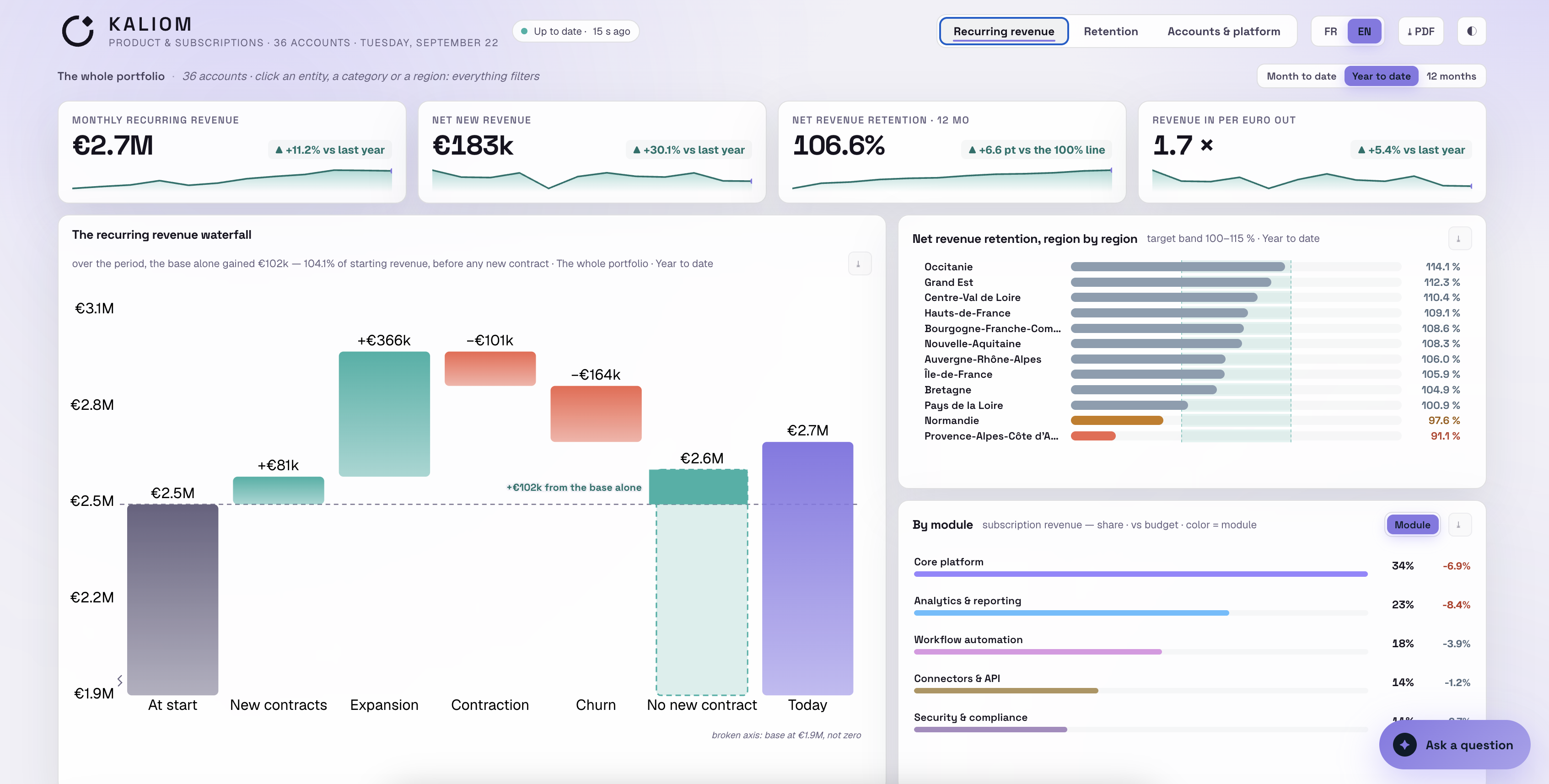
- Monday morning, the numbers are fresh. Refreshes and access rules are watched around the clock, so a broken source is caught before your meeting, not during it.
- A question comes up mid-week. You ask for a new view or a change directly in the app, in plain language. It is done within 24 hours.
- A source changes. The provider adapts the connection and checks the numbers. You hear about it only if it affects you.
- Each release is signed. A named person reviews what ships before it reaches your team.
That is what "run for you" should feel like: no ticket queue, no internal owner to chase, no slow drift back to spreadsheets.
Can AI build and maintain a business dashboard on its own?
AI can build one. Maintaining it is a different job, and it still needs an owner. In 2026, ChatGPT and Claude can connect to your data and produce an interactive dashboard in an afternoon. We cover what they do well in can you build a business dashboard with Claude or ChatGPT?
What they do not do on their own is decide what "revenue" means for your company, notice that last night's refresh failed, or answer when a number on the board slide is wrong. Someone on your side has to prompt, check and maintain. That is why an AI-built dashboard is a prototype, not a product, and why DIY AI analytics has a hidden cost.
A managed service built on AI keeps the speed and removes the upkeep: AI agents do the building and running, and a human signs off on what ships.
What should you ask a managed dashboard provider?
Eight questions, and what a good answer sounds like.
| Ask | A good answer |
|---|---|
| Will you build and maintain the dashboards? | Yes, both, for as long as we work together. |
| Can you connect to our exact tools? | A named list that includes yours, checked before kickoff. |
| Who notices when a refresh fails? | We do, through monitoring, before you see it. |
| What happens when a source changes? | We adapt the connection and check the numbers. No new contract. |
| Who defines metrics like revenue or churn? | We agree on them with you, once, and every dashboard uses the same definition. |
| How do we request a change, and how fast is it done? | A clear channel and a committed delay, in hours or days, not "next sprint." |
| Who signs off on what ships? | A named person who reviews each release. |
| Is pricing predictable? | A fixed recurring cost, not per seat, per hour or per change. |
Also ask to click through a live app the provider runs today. You can explore a live demo app built by the Crew.
When is a managed dashboard service the wrong choice?
Be honest about fit. It is the wrong choice if:
- You already have a data team that builds and maintains dashboards well, and mostly needs software.
- Analytics is the product you sell, and you need to own the function end to end.
- One or two simple dashboards are enough, and someone on your side is happy to keep them up to date.
If you are weighing it against recruiting, see before you hire a data analyst: the managed alternative.
How does Toucan AI Crew run your dashboards?
Toucan AI Crew is a managed analytics service: a supervised crew of AI agents, backed by Toucan's data experts, that builds and runs your custom data apps, with a first result in 48 hours and a human who signs every release.
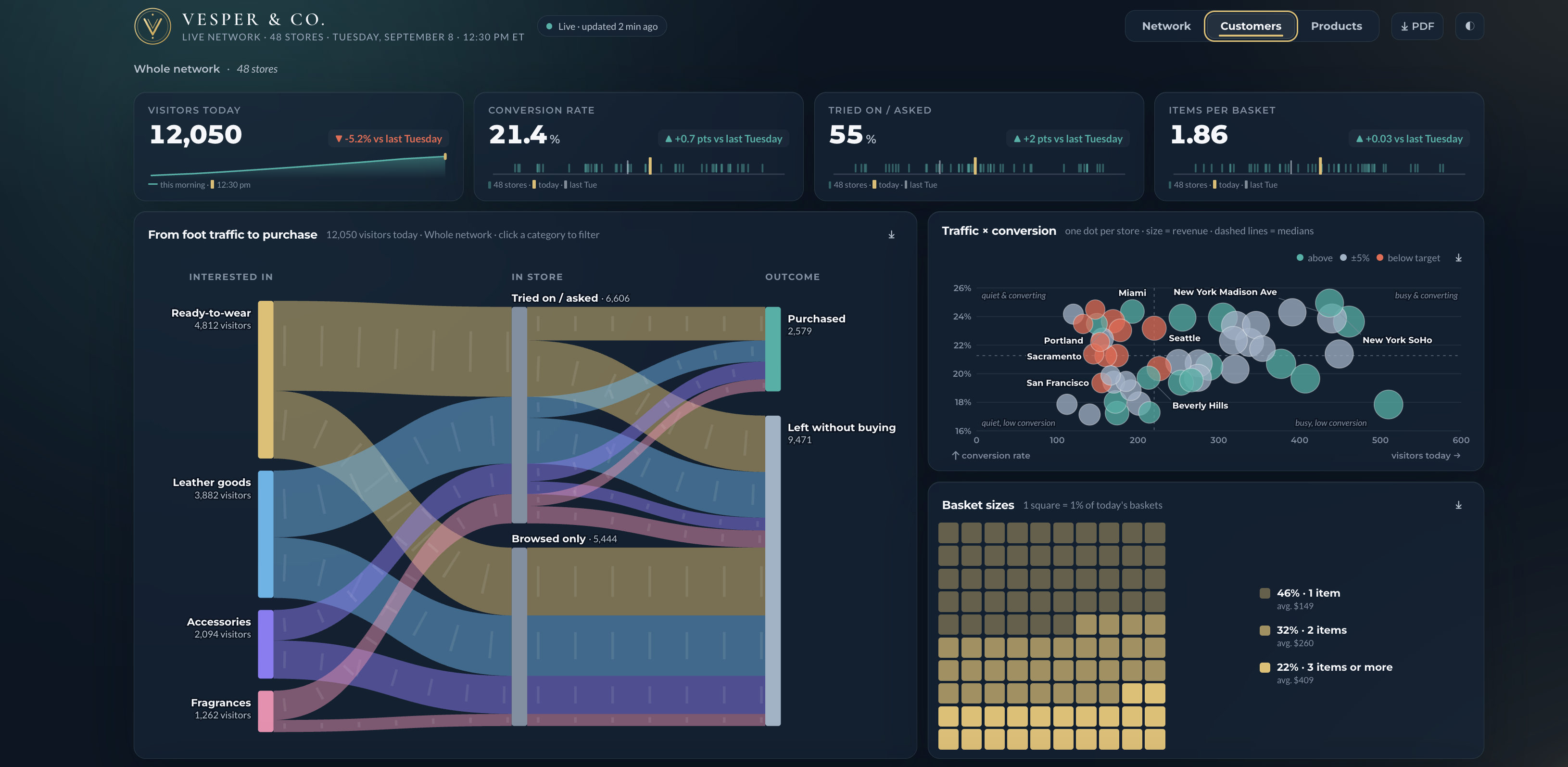
- Built for your business. Views shaped to how each team decides, including visualizations a standard BI tool does not offer. More on that in beyond dashboards: what a custom data app actually is.
- Governed. One definition per metric in a semantic layer, and row-level security so each person sees exactly their data.
- Run continuously. The AI agents watch freshness and access rules around the clock and keep the context of your business from one change to the next.
- Fast to change. Requests are unlimited, made directly in the app, and each one is done within 24 hours.
- Signed by a human. A named Toucan Lead reviews every release before it reaches you.
The first version lands 48 hours after kickoff, production comes at day 30, and all of it costs a fraction of a hire or a consulting firm. See how it works and how pricing works.
So, who should run your dashboards?
If you have a data team, they should. If you do not, do not ask your best operator to become one on the side. Have the dashboards built and run for you, and keep your team on the decisions.
Let's talk. Tell us the decisions your teams need to make. We will show you the first version of your dashboards in 48 hours.
For the wider picture on where AI fits, see AI for data analysis: LLM, tool, or team?
Frequently asked questions
Who can set up and run reliable dashboards for my business without a data team?
A managed analytics service. It connects your sources, defines your metrics, builds the dashboards and keeps them fresh and correct after launch. Toucan AI Crew does this with AI agents and a named Toucan Lead who signs every release. The first version lands in 48 hours, at a fraction of the cost of a hire.
Can I have someone build and maintain the dashboards my teams use, so we don't have to?
Yes. That is what a managed analytics service is for. With Toucan AI Crew, you brief the Crew at kickoff, get a first version in 48 hours and production at day 30. After that, you ask for changes directly in the app and each one is done within 24 hours.
What is dashboard as a service?
Dashboard as a service means a provider builds your business dashboards and keeps running them for a recurring fee: data connections, metric definitions, refreshes, fixes and changes. It is close to a managed analytics service, which also covers governance, permissions and accountability for the numbers.
Can AI build and maintain a business dashboard on its own?
AI can build one quickly. Maintaining it still needs an owner: someone to define metrics, notice failed refreshes, adapt to source changes and answer for the numbers. A managed service built on AI keeps the speed and handles that upkeep, with a human signing off on each release.
What happens when one of our data sources changes?
With a managed service, the provider adapts the connection and checks the numbers, without a new contract. With Toucan AI Crew, the AI agents watch freshness around the clock, and a Toucan Lead reviews each release before it reaches your team.
How much does a managed dashboard service cost?
It is usually a fixed recurring cost scoped to your needs, not a per-seat license. Compare it with what you would otherwise pay: a hire, a consulting project, or your team's time. Toucan AI Crew is priced on quote and costs a fraction of a hire or a consulting firm.